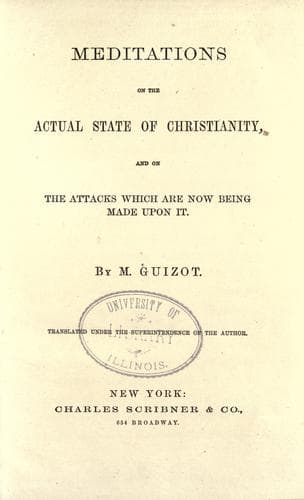
Meditations on the Actual State of Christianity, and on the Attacks Which Are Now Being Made Upon It.Guizot, François
Religion
Meditations on the Actual State of Christianity, and on the Attacks Which Are Now Being Made Upon It.
Guizot, François
Christianity; Philosophy and religion; Religious thought -- 19th century
At the commencement of this century, and in the years which
followed the promulgation of the Concordat, the Protestants, like
the Catholics in France, thought only of the re-establishment of
their worship and of the liberty of their faith. A liberty the
more precious in their eyes, as it followed upon two centuries of
persecutions and of sufferings of which we cannot, in these days,
read the accounts without mingled sentiments of astonishment, of
indignation, and of sorrow. Faithfully should men guard the
memory of such outrages; they would be infinitely better than
they are if they had always present to their minds the vivid
pictures of the iniquities and woes which fill the page of their
history; and evils would not so soon recur if they were not so
soon forgotten. The system of Terrorism under the Revolution had
confounded Catholic and Protestant in a common oppression; it had
abolished the forms of worship of each, denied all free
expression of opinion to Christians; and without distinction
condemned to the same scaffold the "pastors of the desert" and
the bishops of the Court of Versailles--Rabaut Saint-Etienne as
well as the nuns of Verdun.
{130}
When this terrible regime had ceased to exist, neither party had
religiously or politically any desires or pretensions that were
not extremely moderate: the one thing regarded by all as the
sovereign good was, the right to live without molestation and the
liberty to address their prayers to God in the light of day. No
other subject so seriously interested them; and they heartily
wished to show their gratitude and deference to the Government,
which, while it gave security to their bodies, permitted their
souls to breathe freely. The condition of the Protestants was in
one sense better than that of the Catholics, for the former were
now experiencing the joy, not only of a deliverance but of a
positive conquest; they had just escaped as well from the system
of Terrorism, as from the ancient régime; they had lost nothing
to regret; no revengeful feeling made them desire a reaction;
their sole aspiration was for the consolidation of their rights,
and of their new acquisitions.
{131}
"You who lived, as we did, under the yoke of intolerance," (thus
they were addressed in 1807 by M. Rabaut-Dupuy, formerly
president of the legislative body, and the last surviving son of
one of their most estimable pastors,) "you, the relics of so many
persecuted generations, behold! compare! It is no longer in the
desert and at the peril of your lives that you render to the
Creator the homage which is his due. Our temples are restored to
us, and every day beholds new ones erected. Our pastors are
recognized as public functionaries; they receive salaries from
the State; a barbarous law no longer suspends the sword over
their heads. Alas! to those whom we have survived it was
permitted, it is true, to ascend Mount Nebo, and to obtain thence
a glimpse of the promised land, but it is we alone who have taken
possession."
Public-domain text, read in full here on John Shaqi.
Reviews
Reviews
No reviews yet
Be the first to share your thoughts on this work.
Elsewhere in the archive
Join the Discussion
Join the discussion
Sign in to leave a comment or review.
Sign InorCreate an account