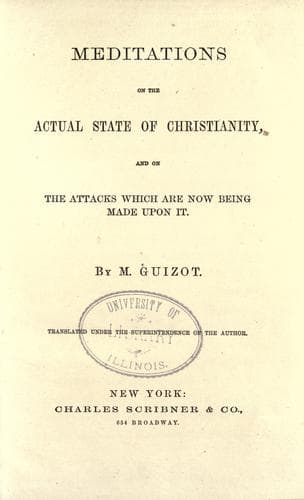
Meditations on the Actual State of Christianity, and on the Attacks Which Are Now Being Made Upon It.Guizot, François
Religion
Meditations on the Actual State of Christianity, and on the Attacks Which Are Now Being Made Upon It.
Guizot, François
Christianity; Philosophy and religion; Religious thought -- 19th century
When, under the Restoration, France had regained her political
liberty, it was not long before that liberty bore its natural
fruits in French Protestantism; it was accompanied, both on
religious and political subjects, by the manifestation of
discordant ideas and discordant tendencies, which were soon to
struggle for victory.
{134}
As at epochs of great intellectual crises eminent men emerge who
represent dominant ideas, so now M. Samuel Vincent and M. Daniel
Encontre immediately appeared in the Protestant Church: both were
pastors, and each worthily represented one of the two principles
which naturally develop themselves in the bosom of Protestantism,
faith in traditions and the right of private judgment; principles
different without being contradictory; principles which may
subsist in peace provided they remain respectively in their
proper places, and within the limits of their rights. M. Samuel
Vincent was a man of a mind remarkably comprehensive and of great
versatility and fecundity; but his habits at the same time were
those of a student, fitting him rather for intellectual
meditation than qualifying him either for expansive sympathies or
for action; he was versed in the philosophy and erudite criticism
of Germany, at that time novel and rare to France; he made the
essence of Christianity, according to his own expression, "to
consist in the liberty of inquiry." [Footnote 14:]
[Footnote 14: Vues sur le protestantisme en France, par M.
Samuel Vincent. 2e édition, p. 15. Paris, 1859.]
{135}
He rejected all written articles of faith, every limited idea of
religious unity, and claimed within the Church, for both pastors
and congregation, the greatest latitude in matters of opinion and
of teaching. But when he clung closely to this view of the
subject, and was pressed to indicate the extreme point to which,
within the Church itself, the diversity of men's individual
beliefs might be carried, his embarrassment became extreme, for
he had too much sense to admit that this diversity had no limit,
and that a Church, whether Protestant or not, could exist without
certain articles of faith common to all its members, and
recognized by them all. "Protestantism," said he himself, "must
not be merely a negation; it should also have its real and
positive side; it must be beyond all things a religion; that is
to say, it must be in the possession of the means to endure and
of the means to edify men by the propagation of a doctrine
benevolent and Christian. ... Christianity is the basis of
ecclesiastical teaching." [Footnote 15]
[Footnote 15: Vues sur le protestantisme en France, par M.
Samuel Vincent, pp. 17, 22.]
{136}
Public-domain text, read in full here on John Shaqi.
Reviews
Reviews
No reviews yet
Be the first to share your thoughts on this work.
Elsewhere in the archive
Join the Discussion
Join the discussion
Sign in to leave a comment or review.
Sign InorCreate an account