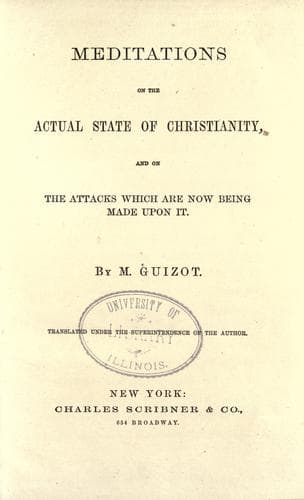
Meditations on the Actual State of Christianity, and on the Attacks Which Are Now Being Made Upon It.Guizot, François
Religion
Meditations on the Actual State of Christianity, and on the Attacks Which Are Now Being Made Upon It.
Guizot, François
Christianity; Philosophy and religion; Religious thought -- 19th century
In 1816 and 1817 the evangelical reaction made rapid progress,
and the body of Genevese pastors resolved to combat it by the
voice of authority. They found, however, no better method of
doing so than by insisting upon what, twelve years later, even M.
Samuel Vincent did not scruple to recommend; they prescribed
silence even whilst they proclaimed liberty. "Without"--these are
their words--"giving any judgment upon the questions really
involved, and without controlling in any respect the liberty of
opinions," they imposed a solemn engagement both upon students
demanding to be consecrated to the sacred ministry, and upon
ministers candidates for pastoral functions in the Church of
Geneva. It was conceived as follows: "As long as we reside and
preach in the churches of the Canton of Geneva, we promise to
abstain from establishing, either in entire discourses or in
parts of discourses directed to this object, our opinion--first,
of the manner in which the divine nature was incarnate in the
person of Jesus Christ; secondly, of original sin; thirdly, of
the mode in which grace operates, or grace is efficient;
fourthly, of predestination. We promise also not to combat, in
any public discourse, the opinion of any pastors or ministers
touching these subjects." [Footnote 21]
[Footnote 21: Genève religieuse au XIX siècle: par le Baron
de Goltz; p. 153.]
{149}
It is difficult to understand how men ever could have flattered
themselves with the hope of re-establishing peace in the Church
by the employment of so sorry an expedient. Liberty, that has
rent asunder such heavy chains, does not permit itself to be
confined by so flimsy a net. The immediate effect of the
regulation of the Genevese pastors was an outburst of discontent.
The more violent Methodists, MM. Malan and Bost at their head,
proclaimed aloud their separation from the established Church;
the more moderate, among others, MM. Gaussen and Merle d'Aubigné,
persisted in remaining, by right of their ministry, in its bosom,
holding themselves responsible representatives _there_ of
the doctrines of the Reformation, which, in fact, they did
continue to preach and to teach.
{150}
The body of pastors at first used great forbearance toward them,
and respected their liberty; and when the populace, irritated at
the agitation caused in families by the Dissenters, and offended
by the austerity of their precepts, made hostile demonstrations
toward them, the Council of Geneva had the wisdom and fairness to
use measures of repression; but, soon becoming weary of this
painful duty, the Council formally forbade, without its express
permission, any book of religious controversy to be printed at
Geneva.
{151}
The body of pastors soon pronounced as vehement a condemnation of
the moderate Methodists as of the ultra Dissenters. The moderate
Methodists then in their turn resorted to energetic measures in
support of their cause: they founded an evangelical society and a
Public-domain text, read in full here on John Shaqi.
Reviews
Reviews
No reviews yet
Be the first to share your thoughts on this work.
Elsewhere in the archive
Join the Discussion
Join the discussion
Sign in to leave a comment or review.
Sign InorCreate an account