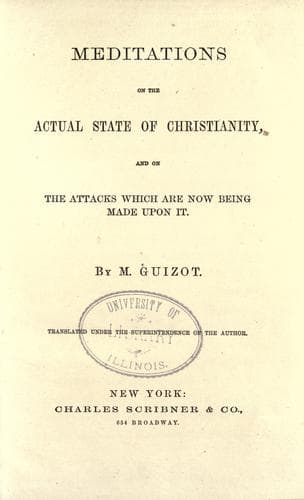
Meditations on the Actual State of Christianity, and on the Attacks Which Are Now Being Made Upon It.Guizot, François
Religion
Meditations on the Actual State of Christianity, and on the Attacks Which Are Now Being Made Upon It.
Guizot, François
Christianity; Philosophy and religion; Religious thought -- 19th century
pastors who had at first shared in the evangelical movement at
Geneva, MM. Neff, Pyt, Bost, Gonthier, scattered themselves over
France, some assuming functions as local pastors, others as
traveling missionaries, attracting to their proximity groups of
zealous Protestants, animating the lukewarm, and erecting in
every place where they made any stay little centers of
Christianity, which radiated to the neighboring country around.
{154}
Distinct associations, some officially recognized by the State,
others having no public character, [Footnote 23] gave to the
labors of isolated individuals the publicity, the unity, the
permanence which they required; and a special organization
(colportage biblique) which at its commencement numbered only
seven, but a few years afterward had sixty agents, all of them,
although obscure individuals, as zealous as their patrons were
zealous, caused the Holy Scriptures and religious tracts to
penetrate into parts of France hopelessly inaccessible to any
other method of communication and of instruction.
[Footnote 23: La Société biblique, la Société pour
l'encouragement de l'instruction primaire parmi les
protestants, la Société évangélique de France, la Société des
traités religieuse, la Société des missions protestantes, la
Société centrale pour les intérêts protestants, la Société
d'évangelisation, etc.]
{155}
To a movement so earnest and so general, although propagated by a
small number of persons in the heart of a population itself
forming but a small minority in the nation at large, obstacles
would inevitably occur. They were encountered on all hands and of
all kinds, religious and political--from the administration, from
popular prejudices, from the distrust of the Government, from the
hostility of the Roman Catholic clergy, from differences of
opinion on theological points among Protestants themselves, from
the _amour propre_ of individuals, and the perplexed or
timorous ideas of subalterns in authority. The activity of the
Protestant societies created uneasiness in bishops and priests,
who strove not merely to counteract their influence, but to
interfere with their liberty of action. Mayors of towns, judges
of the peace, sometimes too, magistrates and administrators of
more elevated rank, lent their aid to these exceptionable
proceedings. Hence arose suspicions, complaints, and struggles
which retarded the new-born impulse of awakening Christianity.
{156}
But the earnest perseverance of its patrons, the general wisdom
of the supreme Government, and the authority, growing more and
more each day, of the principles of justice and of liberty,
gradually surmounted all these obstacles. It was the Restoration
that recognized the chief Protestant societies and gave them the
sanction of the law. Under the Government of 1830 they used their
rights with more confidence and fewer hinderances. The equitable
intentions of King Louis Philippe and of his counselors upon
Public-domain text, read in full here on John Shaqi.
Reviews
Reviews
No reviews yet
Be the first to share your thoughts on this work.
Elsewhere in the archive
Join the Discussion
Join the discussion
Sign in to leave a comment or review.
Sign InorCreate an account