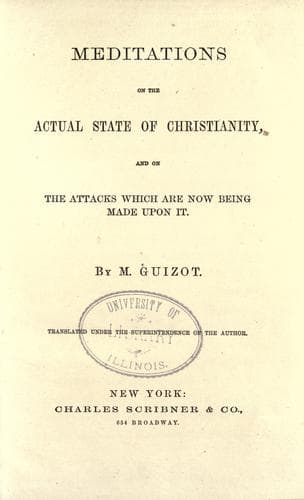
Meditations on the Actual State of Christianity, and on the Attacks Which Are Now Being Made Upon It.Guizot, François
Religion
Meditations on the Actual State of Christianity, and on the Attacks Which Are Now Being Made Upon It.
Guizot, François
Christianity; Philosophy and religion; Religious thought -- 19th century
This passionate admirer of the beautiful, this critic, so
liberal-minded and so impartial, was a sound and uncompromising
moralist, as well as a pious and firm Christian. The predominant
idea of all his literary judgments is moral; and this determines
the tone of his criticism, and the impression which it leaves
behind it, without ever rendering it either harsh, or illiberal,
or narrow-minded. In the sphere of positive belief, without
importing into controversies between believer and believer any
microscopic criticism of detail, M. Vinet has never, upon the
divine origin and the fundamental dogmas of Christianity, had the
least hesitation, never made the smallest concession; he grapples
directly with the most specious and the most popular objections
of his adversaries, and combats them with a conviction the
expression of which becomes more and more eloquent the clearer
and the more complete its manifestation. "To attempt to
distinguish morality from dogma," he says, "is to attempt to
distinguish a river from its source.
{173}
The Christian dogma is at its outset a morality, although a
Christian one. Just as God, in the creed of Christianity, reveals
himself under a form that nature did not announce, Christian
morality, in its turn, invests itself with a character that
nature would never have impressed upon it. Man finding his own
inability to make himself a religion, God came to aid him in his
weakness. It is now rather more than eighteen centuries since, in
an obscure corner of the world, there appeared a man. I do not
say that a long series of prophets had announced the coming of
that man; that a long series of miracles had marked with the seal
of God the nation where he was to be born, and even the prophecy
which foretold him; that, in a word, an imposing mass of evidence
surrounds and authenticates him. I say merely that that man
preached a religion. That religion is not natural religion; the
dogmas of the existence of God and of the soul's immortality are
everywhere taken for granted in his discourses--never taught,
never proved.
{174}
Neither are the ideas which he teaches deduced logically from the
primitive axioms of reason; that which he teaches, that which
forms the substance of his doctrine, embraces subjects which
confound the reason, and to which the reason has neither way nor
access; he preaches a God on earth, a God man, a God poor, a God
crucified; he preaches wrath involving the innocent, mercy
exempting the guilty from all condemnation, God the victim of
man, and man forming one person with God; he preaches a new
birth, without which man can never be saved; he preaches the
sovereignty of God's grace, and the plenitude of the liberty of
man. I do not in any way qualify his teaching; I give them to you
as they are, and without disguise; I seek not to justify them.
You may, if you please, feel surprise, you may take offense;
scruple not to do so. But when you have to your heart's content
Public-domain text, read in full here on John Shaqi.
Reviews
Reviews
No reviews yet
Be the first to share your thoughts on this work.
Elsewhere in the archive
Join the Discussion
Join the discussion
Sign in to leave a comment or review.
Sign InorCreate an account