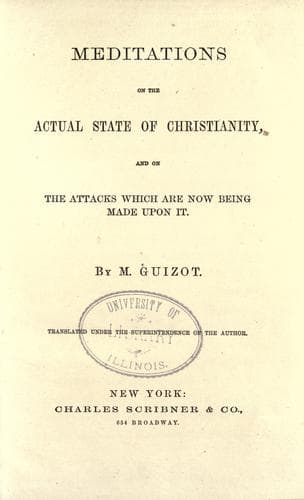
Meditations on the Actual State of Christianity, and on the Attacks Which Are Now Being Made Upon It.Guizot, François
Religion
Meditations on the Actual State of Christianity, and on the Attacks Which Are Now Being Made Upon It.
Guizot, François
Christianity; Philosophy and religion; Religious thought -- 19th century
6. Études sur Pascal. 1848, 1856.
7. Chrestomathie Française, Histoire de la littérature
Française au XVIII siècle, et Études sur la littérature
Française au XIX siècle. 1829, 1849, 1853, etc.
He wrote, besides, numerous short pieces, and articles in
reviews and journals, suggested by topics of the day.]
Upon a single point, the relations of Church and State, his usual
comprehensiveness of view and independence of thought appeared to
abandon M. Vinet.
{183}
Justly struck and afflicted by his own experience of the
inconveniences of a strict bond between Church and State,
disgusted at the servility and falsity which frequently are,
sometimes on the part of the State, sometimes on the part of the
Church, its results, he concluded that in all cases all alliance
between the two conditions of society is radically vicious; and
he declared their entire separation a general and absolute
principle, the sole reasonable and just system, the sole
efficacious guarantee of truth and of liberty in spirituals or
temporals. He thus ignored, it appears to me, the natural causes
which produce, and the human motives which sanction, a certain
alliance between societies civil and ecclesiastical; he ignored
also the inestimable advantages which, at certain times and in
certain circumstances, each may derive, and has actually derived,
from that alliance. In the United States of America, the entire
separation of the State and of the different Churches was
necessary and salutary, for it was the spontaneous consequence of
the condition of men's minds, and of the position of society.
{184}
In England, in spite of the acts of injustice, and the ills
engendered by the intimate union of the state with a Church
legally constituted and having exclusive privileges, the
coexistence of the Church of England with the freedom, more and
more every day complete and recognized, of the Churches of the
Dissenters, was for the Christian religion a potent principle of
life, of force, and of durability.
And if we go back to the ancient history of Europe, who can doubt
that at the fall of the Roman Empire, if the State and the Church
had not, although distinct institutions, been allied, the
development of Christianity would have been far less energetic,
and its conquest of its barbarous conquerors far more
problematical? This is, I repeat, a question not of principle,
but of time, of place, of circumstance, and of condition of
society. A complete separation of Church and State may be good
and practicable; it is neither the only good system, nor is it
always a practicable system.
{185}
Public-domain text, read in full here on John Shaqi.
Reviews
Reviews
No reviews yet
Be the first to share your thoughts on this work.
Elsewhere in the archive
Join the Discussion
Join the discussion
Sign in to leave a comment or review.
Sign InorCreate an account