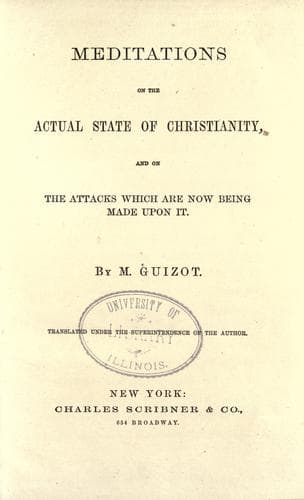
Meditations on the Actual State of Christianity, and on the Attacks Which Are Now Being Made Upon It.Guizot, François
Religion
Meditations on the Actual State of Christianity, and on the Attacks Which Are Now Being Made Upon It.
Guizot, François
Christianity; Philosophy and religion; Religious thought -- 19th century
It is in the name of science and by the processes of science that
the Spiritualists of the nineteenth have combated the Sensualists
of the eighteenth century. They have not, it is true, absolutely
crushed Materialism, that child and legitimate heir of
Sensualism; but while dethroning the parent, they have compelled
the child sometimes to avow himself boldly, sometimes to
transform himself, and to assume other features and other arms
than those of his cradle. I will only cite the lecture of M.
Cousin on the "Sensualistic Philosophy in the Eighteenth
Century," and the essay of the Duke de Broglie on the "Existence
of the Soul," [Footnote 37] written on the occasion of the work
of M. Broussais: "De l'Irrritation et de la Folie."
[Footnote 37: This essay, first inserted in 1828 in the Revue
Française, has been reprinted in the "Ecrits et discours
divers" of the Duke de Broglie, collected and published in
1863.]
{228}
Whoever, after having read them, would still persist in
maintaining the Sensualism of Locke and of Condillac, or in
refusing to see the consequences to which Sensualism leads, would
prove, in my opinion, that he has not understood either the
question put, or the doctrine combated and refuted. We have here
a result acquired for the science of the intellectual world, and
we owe the result to the polemics of the spiritualistic school.
That school has obtained another result more important still, and
which belongs no longer to the polemics of simple negation, but
to positive doctrine; it has set in the broad light of day the
real and fundamental principle of morals, the distinction as to
the essentials of moral good and evil, as well as the law of
obligation, that "categorical imperative," the sole refuge which
Kant found against Skepticism.
229
Neither the interest well defined of each individual, nor the
interest of the greater numbers, nor any sentimental sympathy,
nor any system of positive written law, can, for the future, be
considered as the basis of morals. An attempt is made in the
present day to establish another thesis, and to represent
morality as absolutely independent of religion. Grave error,
which discards from morality, if not its principle, at least its
source and its object, its author and its future; an error,
however, very different from those errors which dispense even
with the principle of morals, and assign as the rule for the
conduct of men, motives having in themselves nothing moral,
nothing absolute. The fact that man's conscience and man's reason
recognize the distinction of moral good and evil, and at the same
time the duty of practicing that good as the law of human
actions, is a fact which we may now regard as acquired to
philosophy.
{230}
The treatise "Du Bien," in the work of M. Cousin upon "Le Vrai,
le Beau, et le Bien," the preface of M. Jouffroy to the "Outlines
of Moral Philosophy," by Dugald Stewart, and the "Essia sur la
Morale," in the "Mélanges Philosophiques," which M. Jouffroy
Public-domain text, read in full here on John Shaqi.
Reviews
Reviews
No reviews yet
Be the first to share your thoughts on this work.
Elsewhere in the archive
Join the Discussion
Join the discussion
Sign in to leave a comment or review.
Sign InorCreate an account