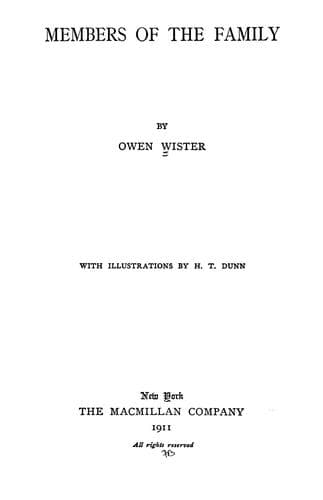
Cowboys -- Fiction; Ranch life -- Fiction; Western stories; Wyoming -- Fiction
Would y’u think it?--after that day I never heard ’em scrappin’ together
again. Maybe they did sometimes, but not in my hearin’. Their experience
seemed to have changed ’em somehow. In the store I’d catch ’em lookin’
at each other. Their eyes was gentle. I think--yes, I think they knowed
that it was coming, that good-by was on its way to them. The
school-house was built in the spring; and after the school got into it,
now and again Jake and Baldy would sneak up to the door, look in and
take a back seat. And one of ’em would say he’d like to ask the kids a
question: Where was Washington, D.C.? And when the answer came, Jake and
Baldy they’d laugh like they’d split and sneak out again. One day in the
store we heard the knockin’ sound of a boat bein’ rowed over the river,
and Baldy came into the store alone. He walks to Edmund, but he looks
down on the floor.
“Jake’s sick,” says he. “Jake’s sick.” Oh, he knowed what it meant.
There was no doctor in the valley, but what could a doctor do? In about
three days we had Baldy sick, too. The tie between ’em was the tie of
life, and Jake died of a Saturday and Baldy died Monday.
“They must be buried by the school-house,” says Miss Carey. And
everybody went. And then up comes the question what to put on the
headboard? It brought up something none of us had thought of.
“Why, we don’t even know their names!” says Miss Carey, very soft.
We didn’t know anything. They had come into the valley, they had made
the valley laugh, they were gone. That was all. Not a fact or a
birthplace or anythin’ to put over them that would tell who they had
been. But Miss Carey wasn’t goin’ to let it be like that. She took it in
charge and she got it right. She found a bit of poetry and she had the
board painted, and it was this way: “Jake and Baldy. Our Friends. Their
heart was free from malice, and all their anger was excess of love.”
And then along in July Edmund got married to Miss Carey. They was sure a
happy two!
“Are y’u still the oldest man in the valley?” I asks Edmund one day in
the store.
“About three and a half,” says Edmund, solemn and deep. But then he
laughs.
Oh, yes, their happiness filled that store, filled the whole cabin,
crowded it. Maybe that’s why I left the valley.
VIII
THE DRAKE WHO HAD MEANS OF HIS OWN
Scipio sat beside the table--Mrs. Culloden’s still very new,
wedding-present table--arguing on and on, and I forgot all about him.
When he slapped the Wyoming game laws for that year down on the table
hard, and complained that I was not listening to him, I continued to
look out of the ranch window at the pond and merely said:--
“Just hear those ducks.”
He stared at me with disgust and scorn. “Ducks!” he then muttered.
“Well, but hear them,” I urged.
“Well, they’re quackin’,” he said. “A duck does.” He picked up the game
laws and resumed: “As I was telling you, it says--page 12, section 25--”
But I gave him no attention and still looked out at the pond.
Public-domain text, read in full here on John Shaqi.
Reviews
Reviews
No reviews yet
Be the first to share your thoughts on this work.
Elsewhere in the archive
Join the Discussion
Join the discussion
Sign in to leave a comment or review.
Sign InorCreate an account