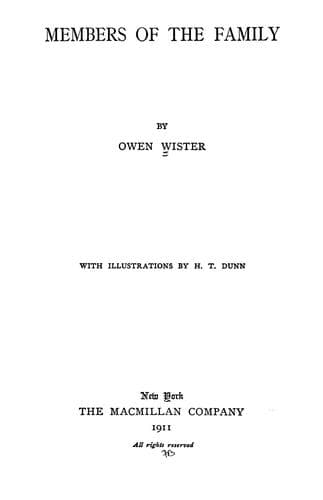
Cowboys -- Fiction; Ranch life -- Fiction; Western stories; Wyoming -- Fiction
When he heard my desire was merely to see Still Hunt Spring, I am not
certain he understood me, or if so, believed me. “Hé!” he exclaimed
again, and laughed because I laughed. “You go this way,” he said,
beginning to trace a groove in the sand. “So.” He laid a match here and
there and pinched up little hillocks, and presently he had it all set
forth. I tore off a piece of wrapping-paper from the stove and copied
the map carefully, with his comments. The place was less distant than I
had thought. I thanked him, spoke of returning “after one snow” to see
him and Still Hunt Spring. “Hé!” he shrugged. Then he mounted his pony,
and rode off without any “good-by,” Indian fashion. I counted it a
treasure I had got from him.
McDonough’s leg had knit well, and I met him on crutches crossing the
parade ground. He was discharged from hospital, and (I will not deny it)
his mere nod of greeting seemed somewhat too scant acknowledgment of the
good will I had certainly tried to show him. Yet his smile was very
pleasant, and while I noted his face, no longer embrowned with sun and
riding, but pale from confinement, I noted also the unsubdued twinkle in
his perplexed eyes. After all, why should I need thanks? As he hobbled
away with his yellow hair sticking out in a cowlick under his hat
behind, I smiled at my own smallness, and wished him good luck heartily.
The doctor, whose hospitable acquaintance I had made on first coming
through the Post this year, would not listen to my paying him anything
for his services to McDonough. Army surgeons were expected, he said, to
render what aid they could to civilians, as well as to soldiers, in the
hospital; he good-humoredly forbade all the remonstrance I attempted.
When civilians could pay him themselves, he let them do so according to
their means; it was just as well that the surrounding country should not
grow accustomed to treating “Uncle Sam” as a purely charitable
institution. McDonough had offered to pay, when he could, what he could
afford. The doctor had thought it due to me to let him know the contents
of my note, and that no such arrangement could be allowed.
“And what said he to that?” I asked.
“Nothing, as usual.”
“Disgusted, perhaps?”
“Not in the least. His myopic eyes were just as cheerful then as they
were the second before he fainted away under my surgical attentions. He
scorned ether.”
“Poor fellow! He’s a good fellow!” I exclaimed.
“M’m,” went the doctor, doubtfully.
“Know anything against him?” I asked.
“Know his kind. All the way from Assiniboine to Lowell Barracks.”
“It has made you hard to please,” I declared.
“M’m,” went the doctor again.
“Think he’ll not pay you?”
“May. May not.”
“Well, good-by, Cynic.”
“Good-by, Tenderfoot.”
Public-domain text, read in full here on John Shaqi.
Reviews
Reviews
No reviews yet
Be the first to share your thoughts on this work.
Elsewhere in the archive
Join the Discussion
Join the discussion
Sign in to leave a comment or review.
Sign InorCreate an account