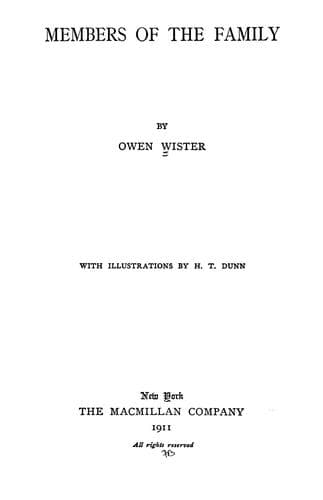
Cowboys -- Fiction; Ranch life -- Fiction; Western stories; Wyoming -- Fiction
I sought out the doctor, soon learning from him that McDonough had paid
him for his services. But this had not softened his opinion of the young
fellow, though he had heard nothing against him, nor even any mention of
his name; he repeated his formula that he had known McDonough’s kind all
the way from Assiniboine to Lowell Barracks, whereupon I again called
him “cynic,” and he retorted with “tenderfoot,” and thus amicably I left
him for my postponed gossip with the post-trader. Him I found
hospitable, but preoccupied, holding a long cigar unlighted between his
taciturn lips. Each topic that I started soon died away: my Eastern
news; my summer plans to ramble with Scipio across the Divide on Gros
Ventre and Snake; the proposed extension of the Yellowstone
Park--everything failed.
“That was quite a company you had this afternoon,” I said, reaching the
end of my resources.
“Yes. Nice gentlemen. Yes.” And he rolled the long, unlighted cigar
between his lips.
“Cattlemen, I suppose?”
“Cattlemen. Yes.”
“Business all right, I hope?”
“Well, no worse than usual.”
Here again we came to an end, and I rose to go.
“Seen your friend McDonough yet?” said he, still sitting.
“Why, how do you know he’s a friend of mine?”
“Says so every time he comes into the Post.”
“Well, the doctor’s all wrong about him!” I exclaimed, and gave my
views. The post-trader watched me in his tilted chair, with a
half-whimsical smile, rolling his eternal cigar, and I finished with the
story of the horse. Then the smile left his face. He got up slowly, and
slowly took a number of turns round his office, pottered with some
papers on his desk, and finally looked at me again.
“Tell me if he does,” he said.
“Offer the horse? I shall not remind him--and I should take it only as a
loan.”
“You tell me if he does,” repeated the post-trader, now smiling again,
and so we parted.
“I wonder what he didn’t say?” I thought as I proceeded to the hotel;
for he had plainly pondered some remarks and decided upon silence.
Between them, he and the doctor had driven me to a strong hope that
McDonough would vindicate my opinion of him by making good his word. At
breakfast next morning at the hotel one of the invariable characters at
such breakfasts, an unshaven person in tattered overalls, with
rope-scarred fists and grimy knuckles, to me unknown, asked:--
“Figure on meeting your friend McDonough?”
“Not if he doesn’t figure on meeting me.”
They all took quiet turns at looking at me until some one remarked:--
“He ain’t been in town lately.”
“I’m glad his leg’s all right,” I said.
“Oh, his leg’s all right.”
The tone of this caused me to look at them. “Well, I hope he’s _all_
all-right!”
Not immediately came the answer: “By latest reports he was enjoying good
health.”
Truly they were a hopeless people to get anything direct from.
Indirectness is by some falsely supposed to be a property of only the
highly civilized; but these latter merely put a brighter and harder
polish on it.
Public-domain text, read in full here on John Shaqi.
Reviews
Reviews
No reviews yet
Be the first to share your thoughts on this work.
Elsewhere in the archive
Join the Discussion
Join the discussion
Sign in to leave a comment or review.
Sign InorCreate an account