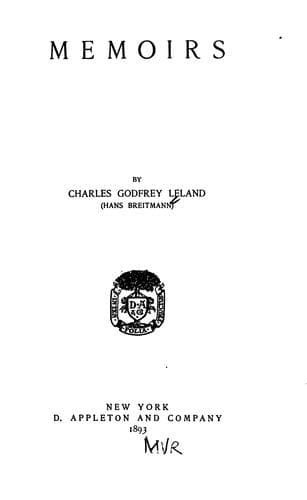
Authors, American -- 19th century -- Biography; Leland, Charles Godfrey, 1824-1903
I replied promptly, "Either an Indian
girl's or an American young lady's, whose ancestors have been two hundred
years in the country." It was the latter. Such feet _lift_ or leap, as
if raised every time to go over entangled grass or sticks. Like an
Indian, I instinctively observe everybody's _ears_, which are unerring
indices of character. I can sustain, and always could endure, incredible
fasts, but for this I need coffee in the morning. "Mark Twain"--whom I
saw yesterday at his villa, as I correct this proof--also has this
peculiar Indian-like or American faculty of observing innumerable little
things which no European would ever think of. There is, I think, a great
deal of "hard old Injun" in him. The most beautiful of his works are the
three which are invariably bound in silk or muslin. They are called "The
Three Daughters, or the Misses Clemens."
It occurred to me, after I had recorded the events of our short but truly
vigorous and eventful campaign, to write to R. W. Gilder and ask
him--_quid memoriae datum est_--"what memories he had of that great war,
wherein we starved and swore, and all but died." There are men in whose
letters we are as sure to find genial _life_ as a _spaccio di vino_ or
wine-shop in a Florentine street, and this poet-editor is one of them.
And he replied with an epistle not at all intended for type, which I
hereby print without his permission, and in defiance of all the custom or
courtesy which inspires gentlemen of the press.
"_May_ _8th_, _1893_.
"EDITORIAL DEPARTMENT, THE CENTURY MAGAZINE,
"UNION SQUARE, NEW YORK.
"MY DEAR LELAND: How your letter carries me back! Do you know that
one night when I was trudging along in the dark over a road-bed where
had been scattered some loose stones to form a foundation, I heard you
and another comrade talking me over in the way to which you refer in
your letter? Well, it was either you or the other comrade who said
you had given me something to eat, and I know that I must have seemed
very fragile, and at times woe-begone. I was possibly the youngest in
the crowd. I was nineteen, and really enjoyed it immensely
notwithstanding.
"I remember you in those days as a splendid expressor of our miseries.
You had a magnificent vocabulary, wherewith you could eloquently and
precisely describe our general condition of starvation, mud,
ill-equippedness, and over-work. As I think of those days, I hear
reverberating over the mountain-roads the call, 'Cannoneers to the
wheels!' and in imagination I plunge knee-deep into the mire and grab
the spokes of the caisson. {266a}
"Do you remember the night we spent at the forge? I burnt my knees at
the fire out-doors, while in my ears was pouring a deluge from the
clouds. I finally gave it up, and spent the rest of the night
crouching upon the fire-bed of the forge itself, most uncomfortably.
Public-domain text, read in full here on John Shaqi.
Reviews
Reviews
No reviews yet
Be the first to share your thoughts on this work.
Elsewhere in the archive
Join the Discussion
Join the discussion
Sign in to leave a comment or review.
Sign InorCreate an account