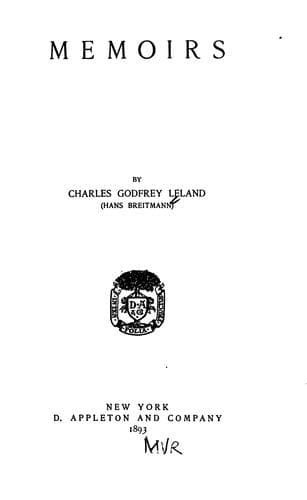
Authors, American -- 19th century -- Biography; Leland, Charles Godfrey, 1824-1903
While in Rome we saw a great deal of W. W. Story, the sculptor, and his
wife and daughter, Edith, for whom Thackeray wrote his most beautiful
tale, and I at my humble distance the ballad of "Breitmann in Rome,"
which contained a remarkable prophecy, of the Franco-German war. At
their house we met Odo Russell and Oscar Browning, and many more whose
names are known to all. It was there also that a lady of the Royal
English household amused us very much one evening by narrating how the
"Breitmann Ballads," owing to their odd mixture of German and English,
were favourite subjects for mutual reading and recitation among the then
youthful members of the Royal family, and what haste and alarm there was
to put the forbidden book out of the way when Her Majesty the Queen was
announced as coming. I also met in Rome the American poet and painter T.
Buchanan Read, who gave me a dinner, and very often that remarkable
character General Carroll Tevis, who, having fought under most flags, and
been a Turkish bey or pacha, was now a chamberlain of the Pope. In the
following year he fought for the French, behaved with great bravery in
Bourbaki's retreat, and was decorated on the field of battle. Then
again, when I was in Egypt, Tevis was at the head of the military
college. He had fairly won his rank of general in the American Civil
War, but as there was some disinclination or other to give it to him, I
had used my influence in his favour with Forney, who speedily secured it
for him. He was a perfect type of the old _condottiero_, but with Dugald
Dalgetty's scrupulous faith to his military engagements. The American
clergyman in Rome was the Rev. Dr. Nevin, a brother of my friend Captain
Nevin. There was also Mrs. John Grigg, an old Philadelphia friend (now
residing in Florence), to whom we were then, as we have continually been
since, indebted for the most cordial hospitality.
Through the kind aid of General Tevis we were enabled to see all the
principal ceremonies of the Holy Week and Easter. This year, owing to
the Council, everything was on a scale of unusual magnificence. I can
say with Panurge that I have seen three Popes, but will not add with him,
"and little good did it ever do me," for Mrs. Leland at least was much
gratified with a full sight and quasi-interview with His Holiness.
There was a joyous sight for a cynic to be seen in Rome in those days--in
fact, it was only last year (1891) that it was done away with. This was
the drawing of the lottery by a priest. There was on a holy platform a
holy wheel and a holy little boy to draw the holy numbers, and a holy old
priest to oversee and _bless_ the whole precious business. The blessing
of the devil would have been more appropriate, for the lotteries are the
curse of Italy. What the Anglo-American mechanic puts into a savings
bank, the Italian invests in lotteries. In Naples there are now fourteen
tickets sold per annum for the gross amount of the population, and in
Florence twelve.
Public-domain text, read in full here on John Shaqi.
Reviews
Reviews
No reviews yet
Be the first to share your thoughts on this work.
Elsewhere in the archive
Join the Discussion
Join the discussion
Sign in to leave a comment or review.
Sign InorCreate an account