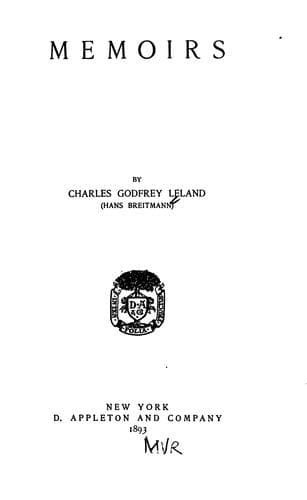
Authors, American -- 19th century -- Biography; Leland, Charles Godfrey, 1824-1903
It is pleasant being anywhere in England in June, and the passing from
picturesque Dover to London through laughing Kent is a good introduction
to the country. The untravelled American, fresh from the "boundless
prairies" and twenty-thousand-acre fields of wheat, sees nothing in it
all but the close cultivation of limited land; but the tourist from the
Continent perceives at once that, with most careful agriculture, there
are indications of an exuberance of wealth, true comfort, and taste
rarely seen in France or Germany. The many trees of a better quality and
slower growth than the weedy sprouting poplar and willow of Normandy; the
hedges, which are very beautiful and ever green; the flowerbeds and walks
about the poorest cottage; the neatly planted, prettily bridged side
roads, all indicate a superiority of wealth or refinement such as
prevails only in New England, or rather which _did_ prevail, until the
native population, going westward, was supplanted by Irish or worse, if
any worse there be at turning neatness into dirty disorder.
That older American population was deeply English, with a thousand rural
English traditions religiously preserved; and the chief of these is clean
_neatness_, which, when fully carried out, always results in simple,
unaffected beauty. This was very strongly shown in the Quaker gardens,
once so common in Philadelphia--and in the people.
We arrived in London, and went directly to the Trubners', No. 29 Upper
Hamilton Terrace, N.W. The first person who welcomed me was Mr.
Delepierre, an idol of mine for years; and the first thing I did was to
borrow half-a-crown of him to pay the cab, having only French money with
me. It was a charming house, with a large garden, so redolent of roses
that it might have served Chriemhilda of old for a romance. For twenty
years that house was destined to be an occasional home and a dwelling
where we were ever welcome, and where every Sunday evening I had always
an appointed place at dinner, and a special arm-chair for the
never-failing Havannah. Mrs. Trubner had, in later years, two boxes of
Havannahs of the best, which had belonged to G. H. Lewes, and which
George Eliot gave her after his death. I have kept two _en souvenir_. I
knew a man once who had formed a large collection of such relics. There
was a cigar which he had received from Louis Napoleon, and one from
Bismarck, and so forth. But, alas! once while away on his travels, the
whole museum was smoked up by a reckless under-graduate younger brother.
_In fumo exit_.
Public-domain text, read in full here on John Shaqi.
Reviews
Reviews
No reviews yet
Be the first to share your thoughts on this work.
Elsewhere in the archive
Join the Discussion
Join the discussion
Sign in to leave a comment or review.
Sign InorCreate an account