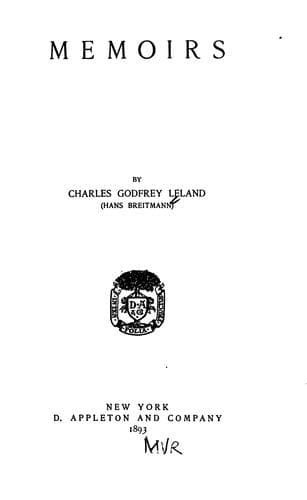
Authors, American -- 19th century -- Biography; Leland, Charles Godfrey, 1824-1903
"If there is anything on earth for which I have envied you, even more
than for your great renown as a poet, it has been because I supposed you
were completely above all such attacks and were utterly indifferent to
them." Which he took amiably, and proceeded to discuss ripe fruit and
wasps--or their equivalent. Yet I doubt whether I was quite in the
right, since those who live for fame honourably acquired must ever be
susceptible to stings, small or great. An editor who receives abusive
letters so frequently that he ends by pitching them without reading into
the waste-basket, and often treats ribald attacks in print in the same
manner--as I have often done--has so many other affairs on his mind that
he becomes case-hardened. But I have observed from long experience that
there is a Nemesis who watches those who arrogate the right to lay on the
rod, and gives it to them with interest in the end.
It was very soon after my arrival in London that I was invited to lunch
at Hepworth Dixon's to meet Lord Lytton, or Bulwer, the great writer. His
works had been so intensely and sympathetically loved by me so long, that
it seemed as if I had been asked to meet some great man of the past. I
found him, as I expected, quite congenial and wondrous kind. I remember
a droll incident. Standing at the head of the stairs, he courteously
made way and asked me to go before. I replied, "When Louis XIV. asked
Crillon to do the same, Crillon complied, saying, 'Wherever your Majesty
goes, be it before or behind, is always the first place or post of
honour,' and I say the same with him," and so went in advance at once. I
saw by his expression that he was pleased with the quotation.
We were looking at a portrait of Shakespeare which Dixon had found in
Russia. Lord Lytton asked me if I thought it an original or true
likeness. I observed that the face was full of many fine seamy lines,
which infallibly indicate great nervous genius of the highest
order--noting at the same time that Lord Lytton's countenance was very
much marked in a like manner. The observation was new to him, and he
seemed to be interested in it, as he always was in anything like
chiromancy or metoscopy. A few days later I was invited to come and pass
nearly a week with Hepworth Dixon at Knebworth, Lord Lytton's country
seat. It is a very picturesque _chateau_, profusely adorned with
fifteenth-century Gothic grotesques, with a fine antique hall, stained
glass windows, and gallery. There is in it a chamber containing a
marvellous and massive carved oak bedstead, the posts of which are human
figures the size of life, and in it and in the same room Queen Elizabeth
is said to have slept when she heard of the destruction of the Spanish
Armada. It was the room of honour, and it had been kindly assigned to
me. It all seemed like a dream.
Public-domain text, read in full here on John Shaqi.
Reviews
Reviews
No reviews yet
Be the first to share your thoughts on this work.
Elsewhere in the archive
Join the Discussion
Join the discussion
Sign in to leave a comment or review.
Sign InorCreate an account