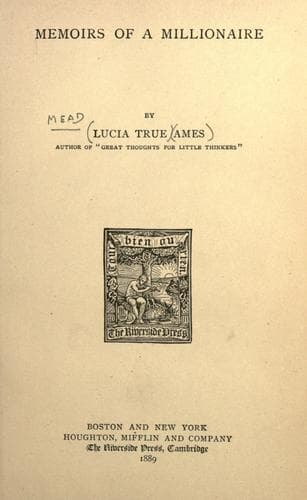
Boston (Mass.) -- Fiction; Women philanthropists -- Fiction
“But this is not all. There are endless things that such a club might
do.
“I hope it will develop all sorts of latent talent and mutual
helpfulness, and lead the way to discussion, comparison, and emulation
in a thousand ways.
“It will give each member an opportunity to make fifty acquaintances
where now he or she has but one,—Protestants and Catholics, Jews and
Gentiles, mechanics, factory operatives, shop-girls, bookkeepers, young
professional men, teachers, millionaires’ daughters, all meeting on the
simple ground of their youth and American citizenship, and giving each
other the pleasure of their company, the benefit of their experience.
And the rich will find that they get even more than they give.”
“But, after all,” I urged, “can you make oil and water mix? Is this a
feasible scheme?”
“That is to say,” answered Mildred, “can people of different social
rank, education, and employments meet socially with mutual profit and
pleasure? That, I am convinced, depends entirely upon the tact and
spirit of genuine friendliness which is exercised by those of the higher
rank.
“Anything that is done perfunctorily is sure to fail, but genuine
interest will create genuine interest. It all depends, you see, upon my
helpers. Without them my money can do nothing. I can only organize; they
must execute. But I am convinced that it is an experiment worth trying.”
“So you are contemplating a social revolution,” said I, as Mildred
paused, her cheeks glowing with the excitement of the thought. “Well,
sister mine, if ever one is brought about, I think it will be by your
way of doing, by trying to put the right people in the right place.
After all, I suppose this one little scheme of yours and Ralph’s, that
may help to start thousands of lives in a different direction, probably
costs no more to permanently endow than what some families would pay for
diamonds and horses and yachts for themselves alone.”
“By the way, Ruby,” asked Mildred the next day, as we sat sipping our
after-dinner coffee, while Ralph had gone out to see some lawyers, “do
you remember the first time I saw you, a little more than a year ago, at
aunt Madison’s?”
“Remember? I wonder if I shall ever forget it, or what you said to those
three rich good-for-nothing”—
“No,” broke in Mildred, “not ‘good-for-nothing,’ though I fear I thought
them so at the time. I fancy I must have spoken pretty savagely, didn’t
I?” Then, without waiting for an answer, she continued: “I felt sure, as
I thought it over afterwards, that they would hate me, that is, if they
took the trouble to think about me at all. But, do you know, I think it
really startled them into asking themselves some pretty plain questions.
“It set them to thinking, and” —she continued with a laugh— “I verily
believe that I was in a measure the humble means of grace which brought
two of them to conviction of sin and led to their conversion.
Public-domain text, read in full here on John Shaqi.
Reviews
Reviews
No reviews yet
Be the first to share your thoughts on this work.
Elsewhere in the archive
Join the Discussion
Join the discussion
Sign in to leave a comment or review.
Sign InorCreate an account