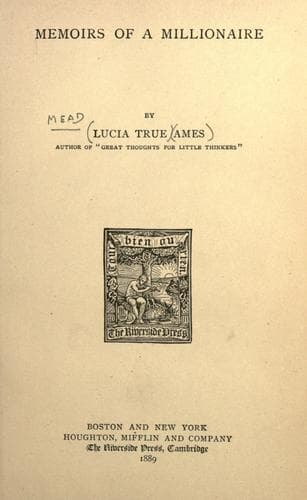
Boston (Mass.) -- Fiction; Women philanthropists -- Fiction
“Mildred Brewster Everett, do you mean to say that you, a woman worth
your tens of millions, are going to come down to living again in a brick
block with little narrow rooms? Are you going to give up the splendid
library, the gallery of rare paintings, the grand music-room, the
conservatories and stables, and all the lovely things that you had
planned?”
Mildred dropped her wax and seal, and turned from her writing-desk with
a gesture of mock despair, as I continued, somewhat vehemently and
without pausing for a reply:—
“Have you forgotten all those magnificent halls, those terra-cottas and
mosaic floors and glorious painted windows? Think of the many times that
we have planned it all out, the baronial fireplaces with the spreading
elk antlers overhead, and the big tiger-skin rugs; and then the cosy,
cushioned window-seats and quaintly carved lattices, the great organ
with golden pipes, and the high, wind-swept turrets with winding stairs!
“Last spring you were planning to bring all this about when the tenement
houses and more necessary things should be under way, and now,” I
continued crossly, “to think of your fancying that you are too poor to
build a beautiful house for yourself, when you have money enough to buy
houses for every one else!”
I think that Mildred had a passion for noble architecture. Her keen eyes
would detect beauties or incongruities where my untrained sight
perceived nothing.
“If a man writes a bad poem, I am not compelled to read it; if he paints
a bad picture, I need not see it more than once,” she was wont to say;
“but if he erects an ugly building in my city he hurts me every time I
walk the street, and I am helpless.”
“When constructive beauty costs no more than this fantastic ugliness,
why must such an absurdity be inflicted upon a long-suffering public?”
she once asked in despair, as we were contemplating an expensive
monument to architectural stupidity. And she never tempered her scorn
when railing at the angular, parti-colored houses, run mad in the
direction of ostentatious eccentricities, which are fast displacing the
simple white dwellings with green blinds that, as she once declared, “at
least have the merit of being modest and wholesome, and do not outrage
all one’s sense of the fitness of things.”
“Wait until I build my house; then you shall see,” she would exclaim,
with a decided little nod which carried the conviction, to one listener
at least, that she would some time show what money and brains combined
could do towards creating an ideal home.
Many an hour, when driving about together, we had amused ourselves, in
the intervals of serious work, in planning the charming mansion which
she would build, and she had entered into it all with great zest.
Public-domain text, read in full here on John Shaqi.
Reviews
Reviews
No reviews yet
Be the first to share your thoughts on this work.
Elsewhere in the archive
Join the Discussion
Join the discussion
Sign in to leave a comment or review.
Sign InorCreate an account