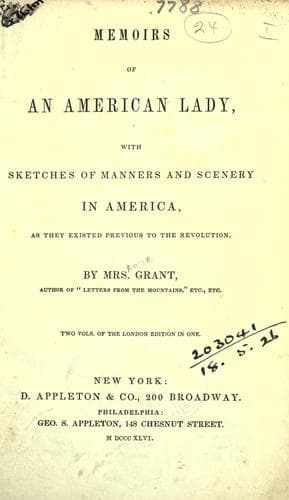
Memoirs of an American Lady: With Sketches of Manners and Scenery in America, as They Existed Previous to the RevolutionGrant, Anne MacVicar
History
Memoirs of an American Lady: With Sketches of Manners and Scenery in America, as They Existed Previous to the Revolution
Grant, Anne MacVicar
Indians of North America; New York (State) -- Social life and customs -- To 1775; Schuyler, Catalina, 1701-1778 or 1779
In ordinary matters, where neither religion nor morality is concerned,
it is much safer to trust to the common sense of mankind in general,
than to our own particular fancy. Singularity of conduct or opinion is
so often the result of vanity or affectation, that whoever ventures upon
it, ought to be a person whose example is looked up to by others. A
person too great to follow, ought to be great enough to lead. But though
her conversation was reserved for those she preferred, her advice,
compassion, and good offices were always given where most needed.
-------
CHAP. XXIX.
Madame’s adopted children—Anecdote of sister Susan.
YEARS passed away in this manner, varied only by the extension of that
protection and education, which they gave to a succession of nephews and
nieces of the colonel or Mrs. Schuyler. These they did not take from
mere compassion, as all their relations were in easy circumstances; but
influenced by various considerations, such as, in some cases, the death
of the mother of the children, or perhaps the father; in others, where
their nieces or nephews married very early, and lived in the houses of
their respective parents, while their young family increased before they
had a settled home; or in instances where, from the remote situations in
which the parents lived, they could not so easily educate them. Indeed,
the difficulty of getting a suitable education for children, whose
parents were ambitious for their improvement, was great; and a family so
well regulated as hers, and frequented by such society, was in itself an
academy, both for the best morals and manners. When people have children
born to them, they must submit to the ordinary lot of humanity; and if
they have not the happiness of meeting with many good qualities to
cultivate and rejoice over, there is nothing left for them but to exert
themselves to the utmost, to reform and ameliorate what will admit of
improvement. They must carefully weed and prop: if the soil produce a
crop both feeble and redundant, affection will blind them to many
defects; imperious duty will stimulate them, and hope, soothing, however
deceitful, will support them. But when people have the privilege, as in
this case, of choosing a child, they are fairly entitled to select the
most promising. This selection, I understood always to have been left to
aunt Schuyler, and it appeared, by the event, to have been generally a
happy one. Fifteen, either nephews or nieces, or the children of such
who had been under her care, all lived to grow up and go out into the
world: all acted their parts so as to do credit to the instruction they
had received, and the example they looked up to. Besides these, they had
many whom they brought for two or three years to their house to reside;
either because the family they came from was at the time crowded with
younger children, or because they were at a time of life, when a year or
Public-domain text, read in full here on John Shaqi.
Reviews
Reviews
No reviews yet
Be the first to share your thoughts on this work.
Elsewhere in the archive
Join the Discussion
Join the discussion
Sign in to leave a comment or review.
Sign InorCreate an account