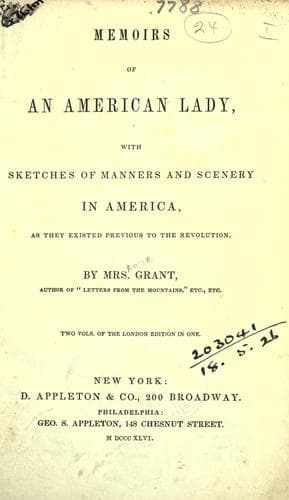
Memoirs of an American Lady: With Sketches of Manners and Scenery in America, as They Existed Previous to the RevolutionGrant, Anne MacVicar
History
Memoirs of an American Lady: With Sketches of Manners and Scenery in America, as They Existed Previous to the Revolution
Grant, Anne MacVicar
Indians of North America; New York (State) -- Social life and customs -- To 1775; Schuyler, Catalina, 1701-1778 or 1779
From this chronicle of past times I derived much information respecting
our good aunt; such as she would not have given me herself. The kindness
of this generous sister-in-law was, indeed, the only light that shone on
the declining days of sister Susan, as she was wont affectionately to
call her. What a sad narrative would the detail of this poor woman’s
sorrows afford! which, however, she did not relate in a querulous
manner, for her soul was subdued by affliction, and she did not “mourn
as those that had no hope.” One instance of self-accusation I must
record. She used to describe the family she left as being no less happy,
united, and highly prosperous, than that into which she came: if,
indeed, she could be said to leave it, going, as she did, for some
months every year to her mother’s house, whose darling she was, and who,
being only fifteen years older than herself, was more like an elder
sister, united by fond affection.
She went to New-York to lie in, at her mother’s house, of her four or
five first children; her mother at the same time having children as
young as hers: and thus caressed at home by a fond husband, and received
with exultation by the tenderest parents; young, gay, and fortunate, her
removals were only variations of felicity; but gratified in every wish,
she knew not what sorrow was, nor how to receive the unwelcome stranger
when it arrived. At length she went down to her father’s as usual, to
lie in of her fourth child, which died when it was eight days old. She
then screamed with agony, and told her mother, who tried by pious
counsel to alleviate her grief, that she was the most miserable of human
beings; for that no one was capable of loving their child so well as she
did hers, and could not think by what sin she had provoked this
affliction: finally, she clasped the dead infant to her bosom, and was
not, without the utmost difficulty, persuaded to part with it; while her
frantic grief outraged all decorum. “After this,” said she, “I have seen
my thirteen grown-up children, and my dear and excellent husband, all
carried out of this house to the grave: I have lost the worthiest and
most affectionate parents, brothers, and sisters, such as few ever had;
and however my heart might be pierced with sorrow, it was still more
deeply pierced with a conviction of my own past impiety and ingratitude;
and under all this affliction, I wept silently and alone—and my outcry
or lamentation was never heard by mortal.” What a lesson was this!
Public-domain text, read in full here on John Shaqi.
Reviews
Reviews
No reviews yet
Be the first to share your thoughts on this work.
Elsewhere in the archive
Join the Discussion
Join the discussion
Sign in to leave a comment or review.
Sign InorCreate an account