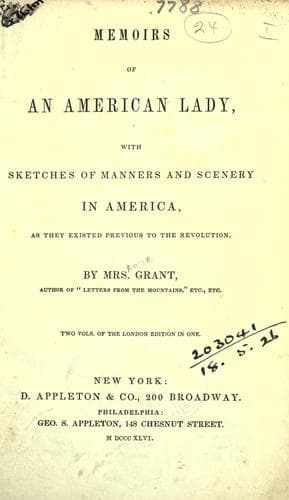
Memoirs of an American Lady: With Sketches of Manners and Scenery in America, as They Existed Previous to the RevolutionGrant, Anne MacVicar
History
Memoirs of an American Lady: With Sketches of Manners and Scenery in America, as They Existed Previous to the Revolution
Grant, Anne MacVicar
Indians of North America; New York (State) -- Social life and customs -- To 1775; Schuyler, Catalina, 1701-1778 or 1779
THE hospitalities of this family were so far beyond their apparent
income, that all strangers were astonished at them. To account for this,
it must be observed that, in the first place, there was, perhaps, scarce
an instance of a family possessing such uncommonly well-trained, active,
and diligent slaves as those I describe. The set that were staid
servants when they married, had some of them died off by the time I knew
the family; but the principal roots from whence the many branches, then
flourishing, sprung, yet remained. These were two women, who had come
originally from Africa while very young; they were most excellent
servants, and the mothers or grandmothers of the whole set, except of
one white-woolled negro-man, who, in my time, sat by the chimney and
made shoes for all the rest. The great pride and happiness of those
sable matrons were, to bring up their children to dexterity, diligence,
and obedience. Diana being determined that Maria’s children should not
excel hers in any quality which was a recommendation to favour; and
Maria equally resolved that her brood, in the race of excellence, should
outstrip Diana’s. Never was a more fervent competition. That of Phillis
and Brunetta, in the Spectator, was a trifle to it: and it was extremely
difficult to decide on their respective merits; for though Maria’s son
Prince cut down wood with more dexterity and despatch than any one in
the province, the mighty Cæsar, son of Diana, cut down wheat, and
threshed it, better than he. His sister Betty, who, to her misfortune,
was a beauty of her kind, and possessed wit equal to her beauty, was the
best sempstress and laundress, by far, I have ever known; and plain,
unpretending Rachael, sister to Prince, wife to Titus, alias Tyte, and
head cook, dressed dinners that might have pleased Apicius. I record my
old humble friends by their real names, because they allowedly stood at
the head of their own class, and distinction of every kind should be
respected. Besides, when the curtain drops, or, indeed, long before it
falls, it is, perhaps, more creditable to have excelled in the lowest
parts, than to have fallen miserably short in the higher. Of the
inferior personages, in this dark drama I have been characterizing, it
would be tedious to tell: suffice it, that besides filling up all the
lower departments of the household, and cultivating to the highest
advantage a most extensive farm, there was a thorough-bred carpenter and
shoemaker, and an universal genius who made canoes, nets, and paddles,
shod horses, mended implements of husbandry, managed the fishing, in
itself no small department, reared hemp and tobacco, and spun both; made
cider, and tended wild horses, (as they called them,) which was his
province to manage and to break. For every branch of the domestic
economy, there was a person allotted—educated for the purpose; and this
society was kept immaculate, in the same way that the quakers preserve
Public-domain text, read in full here on John Shaqi.
Reviews
Reviews
No reviews yet
Be the first to share your thoughts on this work.
Elsewhere in the archive
Join the Discussion
Join the discussion
Sign in to leave a comment or review.
Sign InorCreate an account