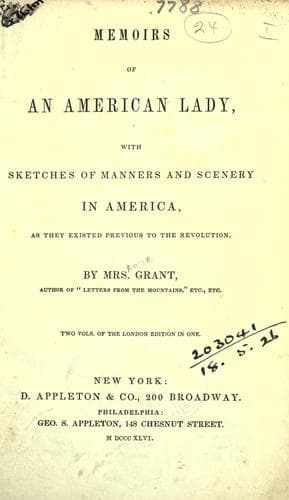
Memoirs of an American Lady: With Sketches of Manners and Scenery in America, as They Existed Previous to the RevolutionGrant, Anne MacVicar
History
Memoirs of an American Lady: With Sketches of Manners and Scenery in America, as They Existed Previous to the Revolution
Grant, Anne MacVicar
Indians of North America; New York (State) -- Social life and customs -- To 1775; Schuyler, Catalina, 1701-1778 or 1779
This question must be left for divines to determine; but sure am I that
humble love and not proud reason, keeps the door of earthly happiness,
as far as it is attainable. I am not going, like the admirable Crichton,
to make an oration in praise of ignorance; but a very high degree of
refinement certainly produces a quickness of discernment, a niggard
approbation, and a fastidiousness of taste, that find a thousand
repulsive and disgusting qualities mingled with those that excite our
admiration, and would, (were we less critical,) produce affection. Alas!
that the tree should so literally impart the knowledge of good and evil;
much evil and little good. It is time to return from this excursion to
the point from which I set out.
The Princes and Cæsars of the Flats had as much to tell of the sagacity
and attachments of the animals, as their mistress related of their own.
Numberless anecdotes that delighted me in the last century, I would
recount, but fear I should not find my audience of such easy belief as I
was, nor so convinced of the integrity of my informers. One circumstance
I must mention, because I well know it to be true. The colonel had a
horse which he rode occasionally, but which oftener travelled with Mrs.
Schuyler in an open carriage. At particular times, when bringing home
hay or corn, they yoked Wolf, for so he was called, in a waggon; an
indignity to which, for a while, he unwillingly submitted. At length,
knowing resistance was vain, he had recourse to stratagem; and whenever
he saw Tyte marshalling his cavalry for service, he swam over to the
island, the umbrageous and tangled border of which I formerly mentioned;
there he fed with fearless impunity till he saw the boat approach;
whenever that happened, he plunged into the thicket, and led his
followers such a chase, that they were glad to give up the pursuit. When
he saw from his retreat that the work was over, and the fields bare, he
very coolly returned. Being, by this time, rather old, and a favourite,
the colonel allowed him to be indulged in his dislike to drudgery. The
mind which is at ease, neither stung by remorse, nor goaded by ambition
or other turbulent passions, nor worn with anxiety for the supply of
daily wants, nor sunk into languor by stupid idleness, forms attachments
and amusements, to which those exalted by culture would not stoop, and
those crushed by want and care could not rise. Of this nature was the
attachment to the tame animals, which the domestics appropriated to
themselves, and to the little fanciful gardens where they raised herbs
or plants of difficult culture, to sell and give to their friends. Each
negro was indulged with his racoon, his great squirrel or muskrat, or
perhaps his beaver, which he tamed and attached to himself, by daily
feeding and caressing him in the farm-yard. One was sure about all such
houses to find these animals, in whom their masters took the highest
pleasure. All these small features of human nature must not be despised
Public-domain text, read in full here on John Shaqi.
Reviews
Reviews
No reviews yet
Be the first to share your thoughts on this work.
Elsewhere in the archive
Join the Discussion
Join the discussion
Sign in to leave a comment or review.
Sign InorCreate an account