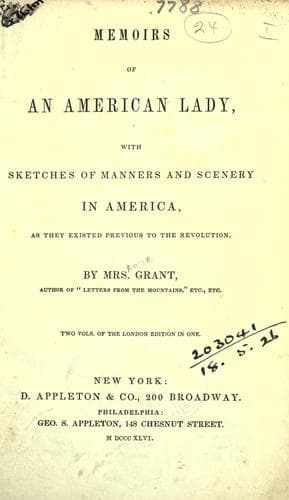
Memoirs of an American Lady: With Sketches of Manners and Scenery in America, as They Existed Previous to the RevolutionGrant, Anne MacVicar
History
Memoirs of an American Lady: With Sketches of Manners and Scenery in America, as They Existed Previous to the Revolution
Grant, Anne MacVicar
Indians of North America; New York (State) -- Social life and customs -- To 1775; Schuyler, Catalina, 1701-1778 or 1779
The same liberal spirit animated her sister, a very excellent person,
who was married to Cornelius Cuyler, then mayor of Albany, who had been
a most successful Indian trader in his youth, and had acquired large
possessions, and carried on an extensive commercial intercourse with the
traders of that day, bringing from Europe quantities of those goods that
best suited them, and sending back their peltry in exchange. He was not
only wealthy, but hospitable, intelligent, and liberal-minded, as
appeared by his attachment to the army, which was, in those days, the
distinguishing feature of those who in knowledge and candour were beyond
others. His wife had the same considerate and prudent generosity, which
ever directed the humanity of her sister; though having a large family,
she could not carry it to so great an extent.
If this maternal friend of their mutual relatives could be said to have
a preference among her own and her husband’s relations, it was certainly
to this family. The eldest son Philip, who bore her husband’s name, was
on that and other accounts, a particular favourite, and was, I think, as
much with them in childhood, as his attention to his education, which
was certainly the best the province could afford, would permit.
Having become distinguished through all the northern provinces, the
common people, and the inferior class of the military, had learned from
the Canadians who frequented her house, to call aunt, Madame Schuyler;
but by one or other of these appellations she was universally known; and
a kindly custom prevailed, for those who were received into any degree
of intimacy in her family, to address her as their aunt, though not in
the least related. This was done oftener to her than others, because she
excited more respect and affection, but it had, in some degree, the
sanction of custom. The Albanians were sure to call each other aunt or
cousin, as far as the most strained construction would carry those
relations. To strangers they were indeed very shy at first, but
extremely kind; when they not only proved themselves estimable, but by a
condescension to their customs, and acquiring a smattering of their
language, ceased to be strangers, then they were generally in the habit
of calling each other cousin; and thus in an hour of playful or tender
intimacy I have known it more than once begin: “I think you like me well
enough, and I am sure I like you very well; come, why should not we be
cousins? I am sure I should like very well to be your cousin, for I have
no cousins of my own where I can reach them. Well, then you shall be my
cousin for ever and ever.” In this uncouth language, and in this artless
manner, were these leagues of amity commenced. Such an intimacy was
never formed unless the object of it were a kind of favourite with the
parents, who immediately commenced uncle and aunt to the new cousin.
This, however, was a high privilege, only to be kept by fidelity and
good conduct.
Public-domain text, read in full here on John Shaqi.
Reviews
Reviews
No reviews yet
Be the first to share your thoughts on this work.
Elsewhere in the archive
Join the Discussion
Join the discussion
Sign in to leave a comment or review.
Sign InorCreate an account