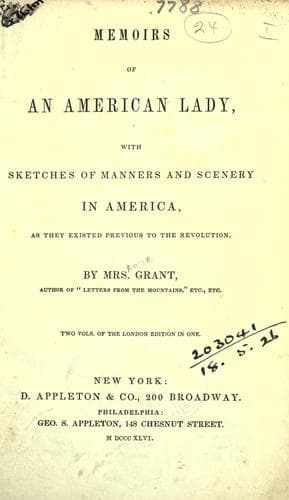
Memoirs of an American Lady: With Sketches of Manners and Scenery in America, as They Existed Previous to the RevolutionGrant, Anne MacVicar
History
Memoirs of an American Lady: With Sketches of Manners and Scenery in America, as They Existed Previous to the Revolution
Grant, Anne MacVicar
Indians of North America; New York (State) -- Social life and customs -- To 1775; Schuyler, Catalina, 1701-1778 or 1779
In the mean while new events were unfolding more fully to the Albanians
the characters of their lately acquired friends. Scandal of fifty years
standing, must, by this time, have become almost pointless. The house
where the young colonel, formerly mentioned, was billetted, and made his
quarters good by every art of seductive courtesy, was occupied by a
person wealthy, and somewhat vain and shallow, who had an only daughter;
I am not certain, but I think she was his only child. She was young,
lively, bold, conceited, and exceedingly well looking. Artless and
fearless of consequences, this thoughtless creature saw every day a
person who was no doubt as much pleased with her as one could be with
mere youth, beauty, and kindness, animated by vivacity, and
distinguished from her companions by all the embellishments which wealth
could procure in that unfashioned quarter; his heart, however, was safe,
as will appear from the sequel. Madame foresaw the consequences likely
to result from an intimacy daily growing, where there was little
prudence on the one side, and as little of that honour which should
respect unsuspecting innocence on the other. She warned the family, but
in vain; they considered marriage as the worst consequence that could
ensue; and this they could not easily have been reconciled to,
notwithstanding the family and fortune of the lover, had not his address
and attentions charmed them into a kind of tacit acquiescence; for, as a
Roman citizen, in the proud days of the republic, would have refused his
daughter to a king, an Albanian, at one period, would rather have his
daughter married to the meanest of his fellow-citizens, than to a person
of the highest rank in the army, because they thought a young person, by
such a marriage, was not only forever alienated from her family, but
from those pure morals and plain manners, in which they considered the
greatest possible happiness to exist. To return:
Public-domain text, read in full here on John Shaqi.
Reviews
Reviews
No reviews yet
Be the first to share your thoughts on this work.
Elsewhere in the archive
Join the Discussion
Join the discussion
Sign in to leave a comment or review.
Sign InorCreate an account