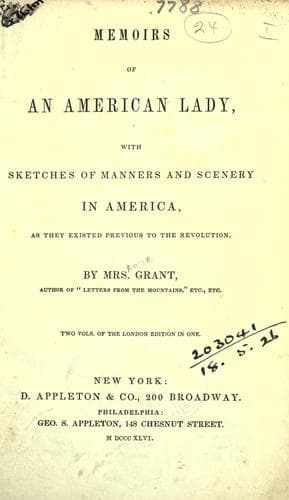
Memoirs of an American Lady: With Sketches of Manners and Scenery in America, as They Existed Previous to the RevolutionGrant, Anne MacVicar
History
Memoirs of an American Lady: With Sketches of Manners and Scenery in America, as They Existed Previous to the Revolution
Grant, Anne MacVicar
Indians of North America; New York (State) -- Social life and customs -- To 1775; Schuyler, Catalina, 1701-1778 or 1779
BY this time matters had gradually assumed a new aspect on this great
continent. The settlement at Albany was no longer an insulated region,
ruled and defended by the wisdom and courage diffused through the
general mass of the inhabitants; but begun, in the ordinary course of
things, to incorporate with the general state. The Mohawk Indians were
so engaged by treaties to assist the army, in its now regular operations
to the westward, that they came less frequently to visit Albany. A line
of forts had, at a prodigious expense, been erected, leading from Albany
to Upper Canada, by the Mohawk river, and the lakes of Ontario, Niagara,
&c. Many respectable engineers were engaged constructing these; some of
them I remember were Swedes, persons of a graceful appearance, polished
manners, and very correct conduct.—These strangers conducted matters
better than our own countrymen; being more accommodating in their
manners, and better accustomed to a severe climate, and inconveniences
of every kind. They were frequent guests at the Flats, were a pleasing
accession to the society, and performed their duty to the public with a
degree of honour and fidelity that checked abuses in others, and rescued
the service they were engaged in, from the reproach which it had
incurred, in consequence of those fungi of society which had at first
intruded into it.
By the advice of the Schuylers, there was now on the Mohawk river a
superintendent of Indian affairs; the importance of which began to be
fully understood. He was regularly appointed, and paid by government.
This was the justly celebrated Sir William Johnson, who held an office
difficult both to execute and define. He might indeed be called the
tribune of the five nations; whose claims he asserted, whose rights he
protected, and over whose minds he possessed a greater sway than any
other individual had ever attained. He was indeed calculated to
conciliate and retain the affections of this brave people; possessing in
common with them many of those peculiarities of mind and manners, that
distinguished them from others. He was an uncommonly tall, well made
man: with a fine countenance; which, however, had rather an expression
of dignified sedateness, approaching to melancholy. He appeared to be
taciturn, never wasting words on matters of no importance: but highly
eloquent when the occasion called forth his powers. He possessed
intuitive sagacity, and the most entire command of temper, and of
countenance. He did by no means lose sight of his own interest, but on
the contrary raised himself to power and wealth, in an open and active
manner; not disdaining any honourable means of benefiting himself: but
at the same time the bad policy, as well as meanness of sacrificing
respectability to snatching at petty present advantages, were so obvious
to him, that he laid the foundation of his future prosperity on the
broad and deep basis of honourable dealing, accompanied by the most
Public-domain text, read in full here on John Shaqi.
Reviews
Reviews
No reviews yet
Be the first to share your thoughts on this work.
Elsewhere in the archive
Join the Discussion
Join the discussion
Sign in to leave a comment or review.
Sign InorCreate an account