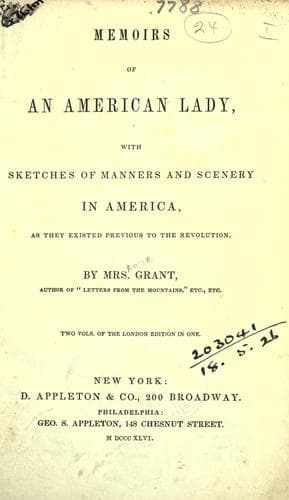
Memoirs of an American Lady: With Sketches of Manners and Scenery in America, as They Existed Previous to the RevolutionGrant, Anne MacVicar
History
Memoirs of an American Lady: With Sketches of Manners and Scenery in America, as They Existed Previous to the Revolution
Grant, Anne MacVicar
Indians of North America; New York (State) -- Social life and customs -- To 1775; Schuyler, Catalina, 1701-1778 or 1779
Soon after this removal, her eldest niece, a remarkably fine young
woman, was married to Mr. C. of C. manor, which was accounted one of the
best matches, or rather the very best in the province. She was
distinguished by a figure of uncommon grace and dignity, a noble and
expressive countenance, and a mind such as her appearance led one to
expect. This very respectable person is, I believe, still living, after
witnessing, among her dearest connections, scenes the most distressing,
and changes the most painful. She has ever conducted herself, so as to
do honour to the excellent examples of her mother and aunt, and to be a
pattern of steadfast truth and generous friendship, in exigencies the
most trying. Her younger sister, equally admired, though possessing a
different style of beauty, more soft and debonair, with the fairest
complexion, and most cheerful simplicity of aspect, was the peculiar
favourite of her aunt, above all that ever she took charge of; she, too,
was soon after married to that highly esteemed patriot, the late Isaac
L., revered through the whole continent for his sound good sense and
genuine public spirit. He was, indeed, “happily tempered, mild, and
firm;” and was finally the victim of steadfast loyalty.
It now remains to say how the writer of these pages became so well
acquainted with the subject of these memoirs.
My father was, at this time, a subaltern in the fifty-fifth regiment.
That body of men were then stationed at Oswego; but during the busy and
warlike period I have been describing, my mother and I were boarded, in
the country below Albany, with the most worthy people imaginable, with
whom we ever after kept up a cordial friendship. My father, wishing to
see his family, was indulged with permission, and at the same time
ordered to take the command of an additional company, who were to come
up, and to purchase for the regiment all the stores they should require
for the winter, which proved a most extensive commission. In the month
of October he set out on this journey, or voyage rather, in which it was
settled that my mother and I should accompany him. We were, I believe,
the first females, above the very lowest ranks, who had ever penetrated
so far into this remote wilderness. Certainly never was joy greater than
that which lulled my childish mind on setting out on this journey. I had
before seen little of my father, and the most I knew of him was from the
solicitude I had heard expressed on his account, and the fear of his
death after every battle. I was, indeed, a little ashamed of having a
military father, brought up, as I had mostly been, in a Dutch family,
and speaking that language as fluently as my own; yet, on the other
hand, I had felt so awkward at seeing all my companions have fathers to
talk and complain to, while I had none, that I thought, upon the whole,
it was a very good thing to have a father of any kind. The scarlet coat,
which I had been taught to consider as the symbol of wickedness,
Public-domain text, read in full here on John Shaqi.
Reviews
Reviews
No reviews yet
Be the first to share your thoughts on this work.
Elsewhere in the archive
Join the Discussion
Join the discussion
Sign in to leave a comment or review.
Sign InorCreate an account