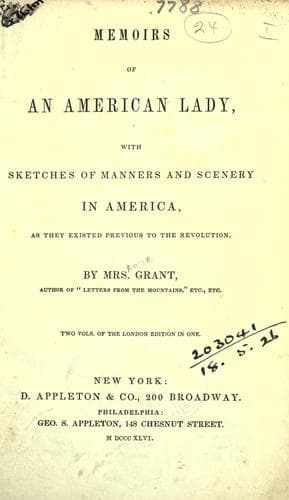
Memoirs of an American Lady: With Sketches of Manners and Scenery in America, as They Existed Previous to the RevolutionGrant, Anne MacVicar
History
Memoirs of an American Lady: With Sketches of Manners and Scenery in America, as They Existed Previous to the Revolution
Grant, Anne MacVicar
Indians of North America; New York (State) -- Social life and customs -- To 1775; Schuyler, Catalina, 1701-1778 or 1779
When giving an account of the garrison I should have mentioned a company
or two, I do not remember which, of engineers, the officers of which,
from their superior intelligence, were a great acquisition to the
society. To these friendly coadjutors the major communicated his plans,
which they readily adopted. Among his concealed stores were Indian corn,
peas, and beans in abundance, and all kinds of garden seeds. Before the
season opened he had arranged with these engineers the plan of a large
garden, bowling green, and enclosed field, for the use of these and all
succeeding troops. This was a bold attempt when one considers you might
as well look for a horse in Venice as in Oswego. No such animal had ever
penetrated so far. A single cow, belonging to the suttler, was the only
tame creature, dogs and cats excepted, to be seen here. But there was a
great stock of palisadoes, which had been cut for the garrison, lying
ready; and their pioneers and workmen still remaining there, the new
erection being scarce complete. The new project was received with
“curses not loud but deep.” Were they to go all out to plod and drudge
for others, who would neither pay nor thank them; for, the most, they
argued they should stay only a year, and reap very little indeed of the
fruit of their labours.
The major’s plans, however, were deep laid; matters wore a peaceable
aspect; and there was no knowing how long they might remain there.
Except shooting in the woods, or fishing, they were without business,
pleasures, or varied society. He feared the men would degenerate into
savage wildness, and their officers into that sordid indifference, which
is, too often, the consequence of being, at the early season of life,
without an aim or a pursuit. He wished to promote a common interest, and
habits social and domestic. He wished, too, that they might make some
advantage of this temporary banishment, to lay by a little store to eke
out their pittance when they returned to more expensive places; in
short, he wished to give them habits of regular economy, which should be
useful to them ever after. He showed them his plans; gave each of them a
department in overseeing the execution of them; and, for that purpose,
each had so many men allotted to his command. He made it obvious to
them, that as the summer was merely to be occupied in gardening and the
chase, the parade of military dress was both expensive and unnecessary.
In the store was a great surplus of soldiers’ coats. These had been sent
from Europe to supply the regiment, which had been greatly diminished in
number by the fatal lines, and succeeding hard march. The major ordered
the regimental tailor to fit these as a kind of short undress frock to
the officers, to whom correspondent little round hats, very different
from the regimental ones, were allotted. Thus equipped, and animated by
the spirit of him who ruled their minds with unconscious yet unlimited
sway, these young Cincinnati set out, nothing loth, on their
Public-domain text, read in full here on John Shaqi.
Reviews
Reviews
No reviews yet
Be the first to share your thoughts on this work.
Elsewhere in the archive
Join the Discussion
Join the discussion
Sign in to leave a comment or review.
Sign InorCreate an account