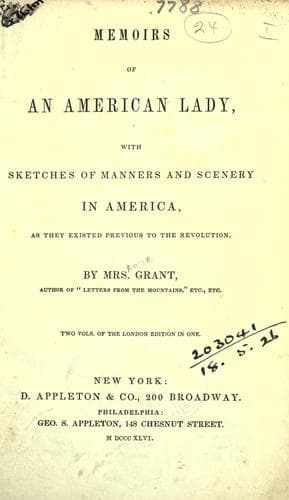
Memoirs of an American Lady: With Sketches of Manners and Scenery in America, as They Existed Previous to the RevolutionGrant, Anne MacVicar
History
Memoirs of an American Lady: With Sketches of Manners and Scenery in America, as They Existed Previous to the Revolution
Grant, Anne MacVicar
Indians of North America; New York (State) -- Social life and customs -- To 1775; Schuyler, Catalina, 1701-1778 or 1779
When the intention was formed by Pondiac and
his associates, of attacking the commodore’s vessel, Sir Robert, who
wished now to be conveyed to some of the forts, discerned the British
ship from the opposite shore of the great lake, and being willing to
avail himself of that conveyance, embarked in a canoe with some of his
own Indian friends, to go on board the commodore. Meanwhile, a very
large canoe, containing as many of Pondiac’s followers as it could
possibly hold, drew near the king’s ship, and made a pretext of coming
in a friendly manner, while two or three others, filled with warriors,
hovered at a distance.—They had fallen short of their usual policy; for
they were painted red, and had about them some of those symbols of
hostility, which are perfectly understood amongst each other. Some
friendly Indians, who happened to be by accident on board the
commodore’s vessel, discerned these, and warned him of the approaching
danger. On their drawing near the vessel, they were ordered to keep off.
Thinking they were discovered, and that things could be no worse, they
attempted to spring on board, armed with their tomahawks and
scalping-knives, but were very soon repulsed. The other canoes, seeing
all was discovered, drew near to support their friends, but were soon
repulsed by a discharge of the six-pounder. At this crisis, the canoe,
containing Sir Robert, began to advance in another direction. The
Indians who accompanied him, had not been apprised of the proposed
attack; but being Hurons, the commodore never doubted of their
hostility. Sir Robert sat in the end of the canoe, dressed in all the
costume of a Huron, and wrapt up in his blanket. He ordered his
companions to approach the ship immediately, not deterred by their
calling to them to keep off, intending, directly, to make himself known;
but in the confusion he was accidentally shot.
To describe the universal sorrow diffused over the province in
consequence of this fatal accident, would be impossible. Nothing since
the death of Lord Howe had excited such general regret. The Indians
carried the body to Detroit, and delivered it up to the garrison for
interment. He had kept a journal during his residence on the lakes,
which was never recovered, and must certainly have contained (proceeding
from such a mind so circumstanced) much curious matter. Sir Charles, his
younger brother, then a captain in the 17th, succeeded him, but had no
visitation of the depression of mind so fatal to his brothers.
Public-domain text, read in full here on John Shaqi.
Reviews
Reviews
No reviews yet
Be the first to share your thoughts on this work.
Elsewhere in the archive
Join the Discussion
Join the discussion
Sign in to leave a comment or review.
Sign InorCreate an account