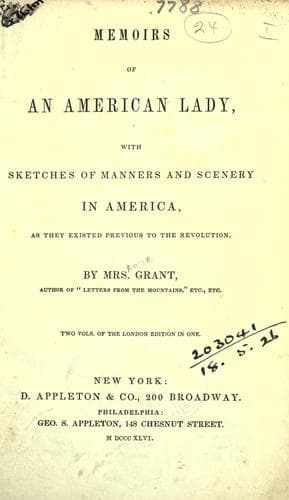
Memoirs of an American Lady: With Sketches of Manners and Scenery in America, as They Existed Previous to the RevolutionGrant, Anne MacVicar
History
Memoirs of an American Lady: With Sketches of Manners and Scenery in America, as They Existed Previous to the Revolution
Grant, Anne MacVicar
Indians of North America; New York (State) -- Social life and customs -- To 1775; Schuyler, Catalina, 1701-1778 or 1779
three years free for clearing, at the end of which, the rents or
purchase money was paid. By that time, any person who had expended much
labour on land, would rather pay a reasonable price or rent for it, than
be removed.
In the progress of his intercourse with these very vulgar, insolent, and
truly disagreeable people, my father began to disrelish the thoughts of
going up to live among them. They flocked indeed so fast, to every
unoccupied spot, that their malignant and envious spirit, their hatred
of subordination, and their indifference to the mother country, began to
spread like a taint of infection.
These illiberal opinions, which produced manners equally illiberal, were
particularly wounding to disbanded officers, and to the real patriots,
who had consulted in former times the happiness of the country, by
giving their zealous co-operation to the troops sent to protect it.
These two classes of people began now to be branded as the slaves of
arbitrary power, and all tendencies to elegance or refinement were
despised as leading to aristocracy. The consequence of all this was,
such an opposition of opinions, as led people of the former description
to seek each other’s society exclusively. Winter was the only time that
distant friends met there, and to avoid the chagrin resulting from this
distempered state of society, veterans settled in the country were too
apt to devote themselves to shooting and fishing, taking refuge from
languor in these solitary amusements.
We had one brave and royal neighbour, however, who saw us often, and was
“every inch a gentleman;” this was Pedrom, aunt’s brother-in-law, in
whom lived the spirit of the Schuylers, and who was our next neighbour
and cordial friend. He was now old, detached from the world, and too
hard of hearing to be an easy companion; yet he had much various
information, and was endeared to us by similarity of principle.
Matters were beginning to be in this state the first winter I went to
live with aunt. Her friends were much dispersed; all conversation was
tainted with politics, Cromwellian politics too, which of all things,
she disliked. Her nephew, Courtlandt Schuyler, who had been a great
Nimrod ever since he could carry a gun, and who was a man of strict
honour and nice feelings, took such a melancholy view of things, and so
little relished that Stamp Act, which was the exclusive subject of all
conversation, that he devoted himself more and more to the chase, and
seemed entirely to renounce a society which he had never greatly loved.
As I shall not refer to him again, I shall only mention here, that this
estimable person was taken away from the evil to come two years after,
by a premature death, being killed by a fall from his horse in hunting.
What sorrows were hid from his eyes by this timely escape from scenes
which would have been to him peculiarly wounding!
Public-domain text, read in full here on John Shaqi.
Reviews
Reviews
No reviews yet
Be the first to share your thoughts on this work.
Elsewhere in the archive
Join the Discussion
Join the discussion
Sign in to leave a comment or review.
Sign InorCreate an account