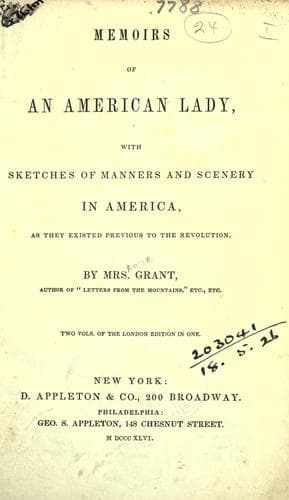
Memoirs of an American Lady: With Sketches of Manners and Scenery in America, as They Existed Previous to the RevolutionGrant, Anne MacVicar
History
Memoirs of an American Lady: With Sketches of Manners and Scenery in America, as They Existed Previous to the Revolution
Grant, Anne MacVicar
Indians of North America; New York (State) -- Social life and customs -- To 1775; Schuyler, Catalina, 1701-1778 or 1779
wide field was open for future contention, merely from the candour and
simplicity of the last generation.
Not in the least distrusting each other, nor aware of the sudden rise of
the value of lands, these primitive colonists got large grants from
government, to encourage their efforts in the early stages of
cultivation; these lands being first purchased, for some petty
consideration, from the Indians, who alone knew the land-marks of that
illimitable forest.
The boundaries of such large grants, when afterwards confirmed by
government, were distinguished by the terms used by the Indians, who
pointed them out; and very extraordinary marks they were. For instance,
one that I recollect. “We exchange with our brother Cornelius
Rensselear, for so many strouds, guns, &c. the lands beginning at the
beaver creek, going on northward, to the great fallen plane tree, where
our tribe slept last summer; then eastward, to the three great cedars on
the hillock; then westward, strait to the wild duck swamp; and strait on
from the swamp to the turn in the beaver creek where the old dam was.”
Such are the boundaries, seriously described in this manner, in one of
the earliest patents. The only mode, then existing, of fixing these
vague limits was to mark large trees which grew at the corners of the
property, with the owner’s name deeply cut, along with the date of the
patent, &c. after blazing, that is to say, cutting deeply into the tree,
for a plain space to hold this inscription.
In this primitive manner were all the estates in the province bounded.
Towards the sea this did very well, as the patents in a manner, bounded
each other; and every one took care to prevent the encroachments of his
neighbour. But in the interior, people took great stretches of land here
and there, where there were not patented lands adjoining; there being no
continuity of fertile ground, except on the banks of streams. The only
security the public had against these trees being cut down, or others at
a greater distance marked in their stead, was a law which made such
attempts penal. This was a very nugatory threat; it being impossible to
prove such an offence. Crimes of this nature, encroaching on the
property of individuals, I believe, rarely happened; but to enlarge
one’s boundary, by taking in a little of king George’s ground, to use a
provincial phrase, was considered as no great harm; and, besides, many
possessed extensive tracts of land unquestioned, merely on the strength
of Indian grants, unsanctioned by government. One in particular, the
proudest man I ever knew, had a law-suit with the king, for more land
than would form a German principality. Now that the inundation of
litigious new settlers, from Massachusetts’ bounds, had awakened the
spirit of inquiry, to call it no worse, every day produced a fresh
law-suit, and all of the same nature, about ascertaining boundaries. In
one instance, where a gentleman was supposed to be unfairly possessed of
Public-domain text, read in full here on John Shaqi.
Reviews
Reviews
No reviews yet
Be the first to share your thoughts on this work.
Elsewhere in the archive
Join the Discussion
Join the discussion
Sign in to leave a comment or review.
Sign InorCreate an account