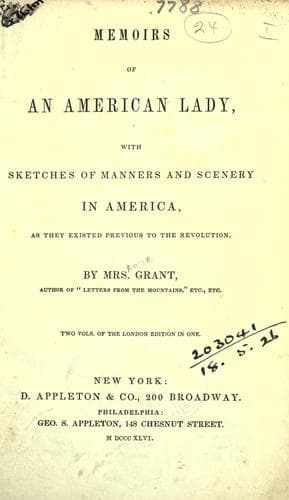
Memoirs of an American Lady: With Sketches of Manners and Scenery in America, as They Existed Previous to the RevolutionGrant, Anne MacVicar
History
Memoirs of an American Lady: With Sketches of Manners and Scenery in America, as They Existed Previous to the Revolution
Grant, Anne MacVicar
Indians of North America; New York (State) -- Social life and customs -- To 1775; Schuyler, Catalina, 1701-1778 or 1779
dividing it from the adjoining one; this division was specified in old
patents, and confirmed by analogy. All at once, however, our new tenants
at will made a discovery, or rather had a revelation, purporting, that
there was a twenty mile line, as they called it, which, in old times,
had been carried thus far beyond the Connecticut River, into the bounds
of what had ever been esteemed the province of New-York. It had become
extremely fashionable to question the limits of individual property, but
for so bold a stroke at a whole province, people were not prepared. The
consequence of establishing this point was, that thus the grants made by
the province of New-York, of lands not their own, could not be valid;
and thus the property which had cost the owners so much to establish and
survey, reverted to the other province, and was no longer theirs. This
was so far beyond all imagination, that though there appeared not the
smallest likelihood of its succeeding, as the plea must, in the end, be
carried to Britain, people stood aghast, and saw no safety in living
among those who were capable of making such daring strides over all
established usage, and ready, on all occasions, to confederate where any
advantage was in view, though ever engaged in litigious contentions with
each other in their original home. This astonishing plea, during its
dependence, afforded these dangerous neighbours a pretext to continue
their usurped possession, till it should be decided to which province
the lands really belonged. They even carried their insolence so far,
that when a particular friend of my father’s, a worthy, upright man,
named Munro, who possessed a large tract of land adjoining to his; when
this good man, who had established a settlement, saw-mills, &c. came to
fix some tenants of his on his lands, a body of these incendiaries came
out, armed, to oppose them, trusting to their superior numbers and the
peaceable disposition of our friend. Now, the fatal twenty mile line ran
exactly through the middle of my father’s property. Had not the
revolution followed so soon, there was no doubt of this claim being
rejected in Britain; but in the mean time it served as a pretext for
daily encroachment and insolent bravadoes. Much of my father’s disorder
was owing to the great conflict in his mind. To give up every prospect
of consequence and affluence, and return to Britain, leaving his
property afloat among these ungovernable people, (to say no worse of
them,) was very hard. Yet to live among them, and by legal coercion,
force his due out of their hands, was no pleasing prospect. His good
angel, it would seem in the sequel, whispered to him to return. Though,
in human prudence, it appeared a fatal measure to leave so valuable a
property in such hands, he thought, first, that he would stay two or
three years; and then, when others had vanquished his antagonists, and
driven them off the lands, which they, in the mean time, were busily
Public-domain text, read in full here on John Shaqi.
Reviews
Reviews
No reviews yet
Be the first to share your thoughts on this work.
Elsewhere in the archive
Join the Discussion
Join the discussion
Sign in to leave a comment or review.
Sign InorCreate an account