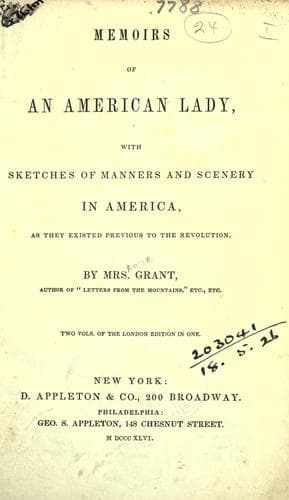
Memoirs of an American Lady: With Sketches of Manners and Scenery in America, as They Existed Previous to the RevolutionGrant, Anne MacVicar
History
Memoirs of an American Lady: With Sketches of Manners and Scenery in America, as They Existed Previous to the Revolution
Grant, Anne MacVicar
Indians of North America; New York (State) -- Social life and customs -- To 1775; Schuyler, Catalina, 1701-1778 or 1779
Description of the Breaking up of the Ice on Hudson’s river.
SOON after this I witnessed, for the last time, the sublime spectacle of
the ice breaking up on the river; an object that fills and elevates the
mind with ideas of power, and grandeur, and, indeed, magnificence;
before which all the triumphs of human art sink into insignificance.
This noble object of animated greatness, for such it seemed, I
witnessed; its approach being announced, like a loud and long peal of
thunder, the whole population of Albany were down at the river side in a
moment; and if it happened, as was often the case, in the morning, there
could not be a more grotesque assemblage. No one who had a night-cap on
waited to put it off; as for waiting for one’s cloak, or gloves, it was
a thing out of the question; you caught the thing next you, that could
wrap round you, and run. In the way you saw every door left open, and
pails, baskets, &c. without number, set down in the street. It was a
perfect saturnalia. People never dreamt of being obeyed by their slaves,
till the ice was past. The houses were left quite empty: the meanest
slave, the youngest child, all were to be found on the shore. Such as
could walk, ran; and they that could not, were carried by those whose
duty would have been to stay and attend them. When arrived at the show
place, unlike the audience collected to witness any spectacle of human
invention, the multitude, with their eyes all bent one way, stood
immoveable, and silent as death, till the tumult ceased, and the mighty
commotion was passed by; then every one tried to give vent to the vast
conceptions with which his mind had been distended. Every child, and
every negro, was sure to say, ‘Is not this like the day of judgment?’
and what they said every one else thought. Now to describe this is
impossible; but I mean to account in some degree for it. The ice, which
had been all winter very thick, instead of diminishing, as might be
expected in spring, still increased, as the sunshine came, and the days
lengthened. Much snow fell in February; which, melted by the heat of the
sun, was stagnant, for a day, on the surface of the ice; and then by the
night frosts, which were still severe, was added, as a new accession to
the thickness of it, above the former surface. This was so often
repeated, that in some years the ice gained two feet in thickness, after
the heat of the sun became such, as one would have expected should have
entirely dissolved it. So conscious were the natives of the safety this
accumulation of ice afforded, that the sledges continued to drive on the
ice, when the trees were budding and every thing looked like spring;
nay, when there was so much melted on the surface that the horses were
knee deep in water, while travelling on it; and portentous cracks, on
every side, announced the approaching rupture. This could scarce have
been produced by the mere influence of the sun, till midsummer. It was
Public-domain text, read in full here on John Shaqi.
Reviews
Reviews
No reviews yet
Be the first to share your thoughts on this work.
Elsewhere in the archive
Join the Discussion
Join the discussion
Sign in to leave a comment or review.
Sign InorCreate an account