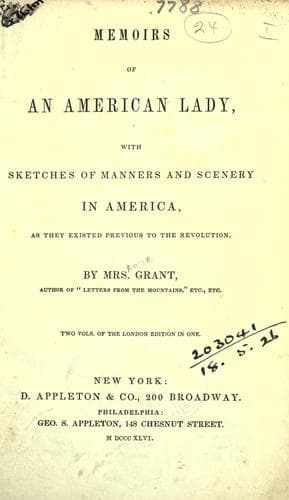
Memoirs of an American Lady: With Sketches of Manners and Scenery in America, as They Existed Previous to the RevolutionGrant, Anne MacVicar
History
Memoirs of an American Lady: With Sketches of Manners and Scenery in America, as They Existed Previous to the Revolution
Grant, Anne MacVicar
Indians of North America; New York (State) -- Social life and customs -- To 1775; Schuyler, Catalina, 1701-1778 or 1779
I do not recollect sparrows there, except the wood sparrow. These little
birds were of various kinds, peculiar to the country; but the one most
frequent and familiar, was a pretty little creature, of a bright
cinnamon colour, called a wren, though little resembling the one to
which we give that name, for it is more sprightly, and flies higher. Of
these and other small birds, hundreds gave and received protection
around this hospitable dwelling. The protection they received consisted
merely in the privilege of being let alone. That which they bestowed was
of more importance than any inhabitant of Britain can imagine. In these
new countries, where man has scarce asserted his dominion, life swarms
abundant on every side; the insect population is numerous beyond belief,
and the birds that feed on them are in proportion to their abundance. In
process of time, when their sheltering woods are cleared, all these
recede before their master, but not before his empire is fully
established. These minute aerial foes are more harassing than the
terrible inhabitants of the forest, and more difficult to expel. It is
only by protecting, and in some sort domesticating, these little winged
allies, who attack them in their own element, that the conqueror of the
lion and tamer of the elephant, can hope to sleep in peace, or eat his
meals unpolluted. While breakfasting or drinking tea in the airy
porticos, which was often the scene of these meals, birds were
constantly gliding over the table with a butterfly, grasshopper, or
cicada in their bills, to feed their young, who were chirping above.
These familiar inmates brushed by without ceremony, while the chirping
swallow, the martin, and other hirundines in countless numbers, darted
past in pursuit of this aerial population, while the fields resounded
with the ceaseless chirping of many gay insects, unknown to our more
temperate summers. These were now and then mingled with the animated and
not unpleasing cry of the tree-frog, a creature of that species, but of
a light, slender form, almost transparent, and of a lively green; it is
dry to the touch, and has not the dank moisture of its aquatic
relations; in short, it is a pretty, lively creature, with a singular
and cheerful note. This loud and not unpleasing insect-chorus, with the
swarms of gay butterflies, in constant motion, enliven scenes, to which
the prevalence of woods, rising “shade above shade,” on every side,
would otherwise give a still and solemn aspect. Several objects, which,
with us, are no small additions to the softened changes and endless
charms of rural scenery, it must be confessed, are wanting there. No
lark welcomes the sun that rises to gild the dark forests and gleaming
lakes of America; no mellow thrush or deep-toned blackbird warbles
through these awful solitudes, or softens the balmy hour of twilight
with
“The liquid language of the groves.”
Public-domain text, read in full here on John Shaqi.
Reviews
Reviews
No reviews yet
Be the first to share your thoughts on this work.
Join the Discussion
Join the discussion
Sign in to leave a comment or review.
Sign InorCreate an account