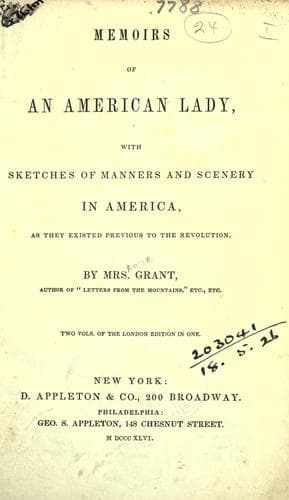
Memoirs of an American Lady: With Sketches of Manners and Scenery in America, as They Existed Previous to the RevolutionGrant, Anne MacVicar
History
Memoirs of an American Lady: With Sketches of Manners and Scenery in America, as They Existed Previous to the Revolution
Grant, Anne MacVicar
Indians of North America; New York (State) -- Social life and customs -- To 1775; Schuyler, Catalina, 1701-1778 or 1779
Twilight itself, the mild and shadowy hour, so soothing to every
feeling, every pensive mind; that soft transition from day to night, so
dear to peace, so due to meditation, is here scarce known, at least only
to have its shortness regretted. No daisy hastens to meet the spring, or
embellishes the meads in summer. Here no purple heath exhales its
wholesome odour, or decks the arid waste with the chastened glow of its
waving bells. No bonny broom, such as enlivens the narrow vales of
Scotland with its gaudy bloom, nor flowering furze, with its golden
blossoms, defying the cold blasts of early spring, animates their sandy
wilds. There the white-blossomed sloe does not forerun the orchard’s
bloom, nor the pale primrose shelter its modest head beneath the tangled
shrubs. Nature, bountiful yet not profuse, has assigned her various
gifts to various climes, in such a manner, that none can claim a decided
pre-eminence; and every country has peculiar charms, which endear it to
the natives beyond any other. I have been tempted by lively
recollections into a digression, rather unwarrantable. To return:
At the back of the large house was a smaller and lower one, so joined to
it as to make the form of a cross. There one or two lower and smaller
rooms below, and the same number above, afforded a refuge to the family
during the rigours of winter, when the spacious summer rooms would have
been intolerably cold, and the smoke of prodigious wood fires would have
sullied the elegantly clean furniture. Here, too, was a sunk story,
where the kitchen was immediately below the eating parlour, and
increased the general warmth of the house. In summer, the negroes
resided in slight outer kitchens, where food was dressed for the family.
Those who wrought in the fields often had their simple dinner cooked
without, and ate it under the shade of a great tree. One room, I should
have said, in the greater house only, was opened for the reception of
company—all the rest were bedchambers for their accommodation, while the
domestic friends of the family occupied neat little bed-rooms in the
attics, or in the winter-house. This house contained no drawing-room;
that was an unheard-of luxury. The winter rooms had carpets—the lobby
had oil-cloth, painted in lozenges, to imitate blue and white marble.
The best bed-room was hung with family portraits, some of which were
admirably executed; and in the eating-room, which, by the by, was rarely
used for that purpose, were some fine scripture paintings:—that which
made the greatest impression on my imagination, and seemed to be
universally admired, was one of Esau, coming to demand the anticipated
blessings. The noble, manly figure of the luckless hunter, and the
anguish expressed in his comely though strong-featured countenance, I
shall never forget. The house fronted the river, on the brink of which,
under shades of elm and sycamore, ran the great road towards Saratoga,
Public-domain text, read in full here on John Shaqi.
Reviews
Reviews
No reviews yet
Be the first to share your thoughts on this work.
Join the Discussion
Join the discussion
Sign in to leave a comment or review.
Sign InorCreate an account