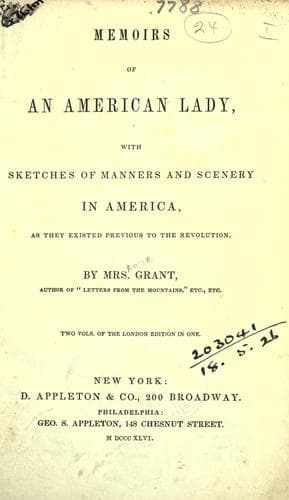
Memoirs of an American Lady: With Sketches of Manners and Scenery in America, as They Existed Previous to the RevolutionGrant, Anne MacVicar
History
Memoirs of an American Lady: With Sketches of Manners and Scenery in America, as They Existed Previous to the Revolution
Grant, Anne MacVicar
Indians of North America; New York (State) -- Social life and customs -- To 1775; Schuyler, Catalina, 1701-1778 or 1779
ADJOINING to the orchard, was the most spacious barn I ever beheld,
which I shall describe for the benefit of such of my readers as have
never seen a building constructed on a plan so comprehensive. This barn,
which, as will hereafter appear, answered many beneficial purposes,
besides those usually allotted for such edifices, was of a vast size, at
least an hundred feet long, and sixty wide. The roof rose to a very
great height in the midst, and sloped down till it came within ten feet
of the ground, when the walls commenced, which, like the whole of this
vast fabric, were formed of wood. It was raised three feet from the
ground, by beams resting on stone—and on these beams was laid, in the
middle of the building, a very massive oak floor. Before the door was a
large sill, sloping downwards, of the same materials. About twelve feet
in breadth, on each side of this capacious building, were divided off
for cattle; on one side ran a manger, at the above-mentioned distance
from the wall, the whole length of the building, with a rack above it;
on the others, were stalls for the other cattle, running also the whole
length of the building. The cattle and horses stood with their hinder
parts to the wall, and their heads projecting towards the threshing
floor. There was a prodigious large box or open chest in one side built
up, for holding the corn after it was threshed; and the roof, which was
very lofty and spacious, was supported by large cross beams; from one to
the other of these was stretched a great number of long poles, so as to
form a sort of open loft, on which the whole rich crop was laid up. The
floor of those parts of the barn, which answered the purposes of a
stable and cow-house, was made of thick slab deals, laid loosely over
the supporting beams; and the mode of cleaning those places, was by
turning the boards, and permitting the dung and litter to fall into the
receptacles left open below for the purpose; from thence, in spring,
they were often driven down to the river—the soil, in its original
state, not requiring the aid of manure. In the front[3] of this vast
edifice, there were prodigious folding doors, and two others that opened
behind.
Footnote 3:
By the front is meant the gable-end, which contains the entrance.
Public-domain text, read in full here on John Shaqi.
Reviews
Reviews
No reviews yet
Be the first to share your thoughts on this work.
Join the Discussion
Join the discussion
Sign in to leave a comment or review.
Sign InorCreate an account