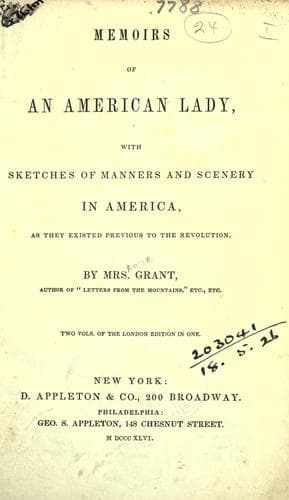
Memoirs of an American Lady: With Sketches of Manners and Scenery in America, as They Existed Previous to the RevolutionGrant, Anne MacVicar
History
Memoirs of an American Lady: With Sketches of Manners and Scenery in America, as They Existed Previous to the Revolution
Grant, Anne MacVicar
Indians of North America; New York (State) -- Social life and customs -- To 1775; Schuyler, Catalina, 1701-1778 or 1779
Certainly never did cheerful rural toils wear a more exhilarating aspect
than while the domestics were lodging the luxuriant harvest in this
capacious repository. When speaking of the doors, I should have
mentioned that they were made in the gable ends; those in the back
equally large, to correspond with those in the front; while on each side
of the great doors were smaller ones, for the cattle and horses to
enter. Whenever the corn or hay was reaped or cut, and ready for
carrying home, which in that dry and warm climate, happened in a very
few days, a waggon, loaded with hay, for instance, was driven into the
midst of this great barn; loaded also with numberless large
grasshoppers, butterflies, and cicadas, who came along with the hay.
From the top of the waggon, this was immediately forked up into the loft
of the barn, in the midst of which was an open space left for the
purpose; and then the unloaded waggon drove, in rustic state, out of the
great door at the other end. In the mean time, every member of the
family witnessed or assisted in this summary process, by which the
building and thatching of stacks was at once saved; and the whole crop
and cattle were thus compendiously lodged under one roof.
The cheerfulness of this animated scene was much heightened by the quick
appearance and vanishing of the swallows, who twittered among their
high-built dwellings in the roof. Here, as in every other instance, the
safety of these domestic friends was attended to, and an abode provided
for them. In the front of this barn were many holes, like those of a
pigeon-house, for the accommodation of the martin—that being the species
to which this kind of home seemed most congenial; and, in the inside of
the barn, I have counted above fourscore at once. In the winter, when
the earth was buried deep in new-fallen snow, and no path fit for
walking in was left, this barn was like a great gallery, well suited for
that purpose, and furnished with pictures, not unpleasing to a simple
and contented mind. As you walked through this long area, looking up,
you beheld the abundance of the year treasured above you; on one side,
the comely heads of your snorting steeds presented themselves, arranged
in seemly order; on the other, your kine displayed their meeker visages;
while the perspective, on either, was terminated by heifers and fillies,
no less interesting. In the midst, your servants exercised the flail;
and even, while they threshed out the straw, distributed it to the
expectants on both sides; while the “liberal handful” was occasionally
thrown to the many-coloured poultry on the hill. Winter itself, never
made this abode of life and plenty cold or cheerless. Here you might
walk and view all your subjects, and their means of support, at one
glance, except, indeed, the sheep, for whom a large and commodious
building was erected very near the barn; the roof of which was furnished
with a loft, large enough to contain hay sufficient for their winter’s
food.
Public-domain text, read in full here on John Shaqi.
Reviews
Reviews
No reviews yet
Be the first to share your thoughts on this work.
Elsewhere in the archive
Join the Discussion
Join the discussion
Sign in to leave a comment or review.
Sign InorCreate an account