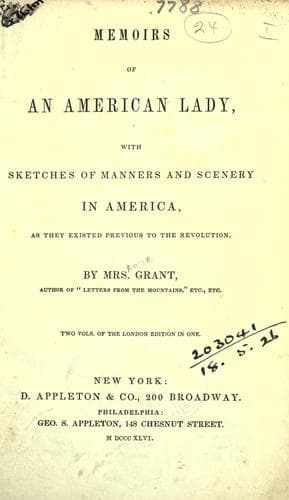
Memoirs of an American Lady: With Sketches of Manners and Scenery in America, as They Existed Previous to the RevolutionGrant, Anne MacVicar
History
Memoirs of an American Lady: With Sketches of Manners and Scenery in America, as They Existed Previous to the Revolution
Grant, Anne MacVicar
Indians of North America; New York (State) -- Social life and customs -- To 1775; Schuyler, Catalina, 1701-1778 or 1779
These additional inhabitants, being such as had suffered real and
extreme hardships for conscience-sake, from absolute tyranny and the
most cruel intolerance, rejoiced in the free exercise of a pure and
rational religion, and in the protection of mild and equitable laws, as
the first of human blessings, which privation had so far taught them to
value, that they thought no exertion too great to preserve them. I
should have formerly mentioned, that, besides the French refugees
already spoken of, during the earliest period of the establishment of
the British sovereignty in this part of the continent, a great number of
the protestants, whom the fury of war, and persecution on religious
accounts, had driven from the Palatinate, during the successful and
desolating period of the wars carried on against that unhappy country by
Lewis the Fourteenth, took refuge here. The subdued and contented
spirit, the simple and primitive manners, and frugal, industrious habits
of these genuine sufferers for conscience-sake, made them an acquisition
to any society which received them, and a most suitable infusion among
the inhabitants of this province, who, devoted to the pursuits of
agriculture and the Indian trade, which encouraged a wild, romantic
spirit of adventure, little relished those mechanical employments, or
that petty yet necessary traffic in shops, &c., to which part of every
regulated society must needs devote their attention. These civic toils
were left to those patient and industrious exiles; while the friendly
intercourse with the original natives, had strongly tinctured the first
colonists with many of their habits and modes of thinking. Like them,
they delighted in hunting; that image of war, which so generally, where
it is the prevalent amusement, forms the body to athletic force and
patient endurance, and the mind to daring intrepidity. It was not alone
the timorous deer or feeble hare that were the objects of their pursuit;
nor could they, in such an impenetrable country, attempt to rival the
fox in speed or subtlety. When they kept their “few sheep in the
wilderness,” the she-bear, jealous of her young, and the wolf, furious
for prey, were to be encountered for their protection. From these
allies, too, many who lived much among them, had learnt that fearless
adherence to truth, which exalts the mind to the noblest kind of
resolution. The dangers they were exposed to, of meeting wandering
individuals, or parties of hostile Indians, while traversing the woods
in their sporting or commercial adventures, and the necessity that
sometimes occurred of defending their families by their own personal
prowess, from the stolen irruptions of detached parties of those usually
called the French Indians, had also given their minds a warlike bent;
and as the boy was not uncommonly trusted at nine or ten years of age,
with a light fowling-piece, which he soon learned to use with great
dexterity, few countries could produce such dexterous marksmen, or
Public-domain text, read in full here on John Shaqi.
Reviews
Reviews
No reviews yet
Be the first to share your thoughts on this work.
Elsewhere in the archive
Join the Discussion
Join the discussion
Sign in to leave a comment or review.
Sign InorCreate an account