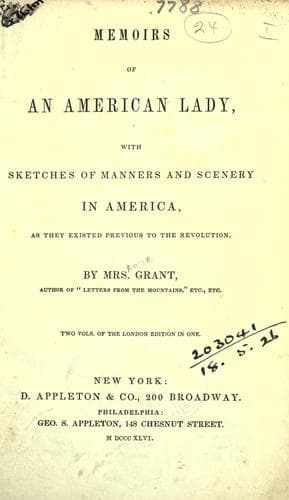
Memoirs of an American Lady: With Sketches of Manners and Scenery in America, as They Existed Previous to the RevolutionGrant, Anne MacVicar
History
Memoirs of an American Lady: With Sketches of Manners and Scenery in America, as They Existed Previous to the Revolution
Grant, Anne MacVicar
Indians of North America; New York (State) -- Social life and customs -- To 1775; Schuyler, Catalina, 1701-1778 or 1779
MRS. SCHUYLER had contributed all in her power to forward this
expedition—but was probably hurt, either by the fatigue of receiving so
many friends, or the anxiety produced by parting with them under such
circumstances; for soon after the colonel’s departure, she was delivered
of a dead child, which event was followed by an alarming illness—but she
wished the colonel to be kept ignorant of it, that he might give his
undivided attention to the duties in which he was engaged. Providence,
which doubtless had singled out this benevolent pair to be the parents
of many who had no natural claim upon their affection, did not indulge
them with any succeeding prospects of a family of their own. This
privation, not a frequent one in this colony, did not chill the minds or
narrow the hearts of people, who, from this circumstance, found
themselves more at liberty to extend their beneficence, and enlarge that
circle which embraced the objects of their love and care. This, indeed,
was not singular, during that reign of natural feeling which preceded
the prevalence of artificial modes in this primitive district. The love
of offspring is certainly one of the strongest desires that the
uncorrupted mind forms to itself in a state of comparative innocence.
Affecting indifference on this subject, is the surest proof of a
disposition either callous, or led by extreme vanity to pretend
insensibility to the best feelings of our nature.
To a tie so exquisitely tender, the pledge and bond of connubial union;
to that bud of promised felicity, which always cheers with the fragrance
of hope, the noon-day of toil or care, and often supports with the rich
cordial of filial love and watchful duty, the evening of our decline,
what mind can be indifferent? No wonder the joys of paternity should be
highly relished, where they were so richly flavoured; where parents knew
not what it was to find a rebel or a rival in a child; first, because
they set the example of simplicity, of moderation, and of seeking their
highest joys in domestic life; next, because they quietly expected and
calmly welcomed the evening of life; and did not, by an absurd desire of
being young too long, inspire their offspring with a premature ambition
to occupy their place. What sacrifices have I not seen made to filial
piety! How many respectable, (though not young) maidens, who, without
pretending a dislike to marriage, have rejected men whom their hearts
approved, because they would not forsake, during her lifetime, a widowed
mother, whose sole comfort they were!
Public-domain text, read in full here on John Shaqi.
Reviews
Reviews
No reviews yet
Be the first to share your thoughts on this work.
Elsewhere in the archive
Join the Discussion
Join the discussion
Sign in to leave a comment or review.
Sign InorCreate an account