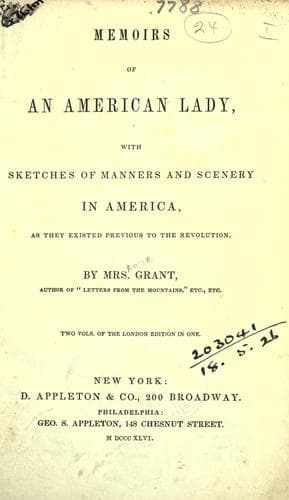
Memoirs of an American Lady: With Sketches of Manners and Scenery in America, as They Existed Previous to the RevolutionGrant, Anne MacVicar
History
Memoirs of an American Lady: With Sketches of Manners and Scenery in America, as They Existed Previous to the Revolution
Grant, Anne MacVicar
Indians of North America; New York (State) -- Social life and customs -- To 1775; Schuyler, Catalina, 1701-1778 or 1779
POPULATION extending to the milder regions of Europe, brought
civilization along with it, so that it is only among the savages, (as we
call our ancestors) of the north, that we can trace the intermediate
state I have spoken of. Amongst them, one regular gradation seems to
have taken place; they were first hunters and then warriors. As they
advanced in their knowledge of the arts of life, and acquired a little
property, as much of pastoral pursuits as their rigorous climate would
allow, without the aid of regular agriculture, mingled with their
wandering habits. But, except in a few partial instances, from hunters
they became conquerors; the warlike habits acquired from that mode of
life, raising their minds above patient industry, and teaching them to
despise the softer arts that embellish society. In fine, their usual
process was to pass to civilization through the medium of conquest. The
poet says,
“With noble scorn the first fam’d Cato viewed,
Rome learning arts from Greece, which she subdued.”
The surly censor might have spared his scorn, for doubtless science, and
the arts of peace, were by far the most valuable acquisitions resulting
from their conquest of that polished and ingenious people. But when the
savage hunters of the north became too numerous to subsist on their deer
and fish, and too warlike to dread the conflict with troops more
regularly armed, they rushed down, like a cataract, on their enfeebled
and voluptuous neighbours; destroyed the monuments of art, and seemed,
for a time, to change the very face of nature. Yet dreadful as were the
devastations of this flood, let forth by divine vengeance to punish and
to renovate, it had its use in sweeping away the hoarded mass of
corruption, with which the dregs of mankind had polluted the earth. It
was an awful but a needful process, which, in some form or other, is
always renewed when human degeneracy has reached its ultimatum. The
destruction of these feeble beings, who, lost to every manly and
virtuous sentiment, crawl about the rich property which they have not
sense to use worthily, or spirit to defend manfully, may be compared to
the effort nature makes to rid herself of the noxious brood of wasps and
slugs, cherished by successive mild winters. A dreadful frost comes; man
suffers and complains; his subject animals suffer more, and all his
works are for a time suspended: but this salutary infliction purifies
the air, meliorates the soil, and destroys millions of lurking enemies,
who would otherwise have consumed the productions of the earth, and
deformed the face of nature. In these barbarous irruptions, the
monuments of art, statues, pictures, temples, and palaces, seem to be
most lamented. From age to age, the virtuosi of every country have
re-echoed to each other their feeble plaints over the lost works of art,
as if that had been the heaviest sorrow in the general wreck—and as if
the powers that produced them had ceased to exist. It is over the
Public-domain text, read in full here on John Shaqi.
Reviews
Reviews
No reviews yet
Be the first to share your thoughts on this work.
Elsewhere in the archive
Join the Discussion
Join the discussion
Sign in to leave a comment or review.
Sign InorCreate an account