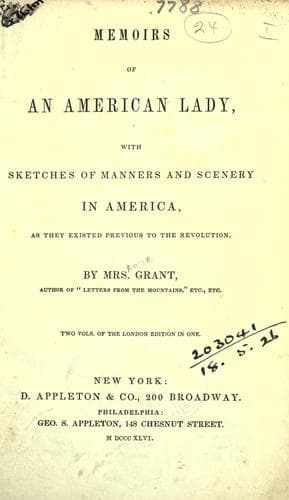
Memoirs of an American Lady: With Sketches of Manners and Scenery in America, as They Existed Previous to the RevolutionGrant, Anne MacVicar
History
Memoirs of an American Lady: With Sketches of Manners and Scenery in America, as They Existed Previous to the Revolution
Grant, Anne MacVicar
Indians of North America; New York (State) -- Social life and customs -- To 1775; Schuyler, Catalina, 1701-1778 or 1779
animals which were to be maintained; and no small expense, in that
country, to procure the implements necessary for the purposes of
agriculture. In other countries, when a poor man has not wherewithal to
begin farming, he serves another, and the reward of his toil enables him
to set up for himself. No such resource was open to the Indians, had
they even inclined to adopt our modes. No Indian ever served another, or
received assistance from any one except his own family. It is
inconceivable, too, what a different kind of exertion of strength it
requires to cultivate the ground, and to endure the fatigues of the
chace, long journeys, &c. To all that induces us to labour they were
indifferent. When a governor of New-York was describing to an Indian the
advantages that some one would derive from such and such possessions;
“Why,” said he, with evident surprise, “should any man desire to possess
more than he uses?” More appeared, to his untutored sense, an
incumbrance.
I have already observed how much happier they considered their manner of
living than ours; yet their intercourse with us daily diminished their
independence, their happiness, and even their numbers. In the New World,
this fatality has never failed to follow the introduction of European
settlers; who, instead of civilizing and improving, slowly consume and
waste—where they do not, like the Spaniards, absolutely destroy and
exterminate the natives. The very nature of even our most friendly mode
of dealing with them, was pernicious to their moral welfare; which,
though too late, they well understood, and could as well explain.
Untutored man, in beginning to depart from that life of exigences, in
which the superior acuteness of his senses, his fleetness and dexterity
in the chace, are his chief dependence, loses so much of all this before
he can become accustomed to, or qualified for our mode of procuring food
by patient labour, that nothing can be conceived more enfeebled and
forlorn, than the state of the few detached families remaining of
vanished tribes, who, having lost their energy, and even the wish to
live in their own manner, were slowly and reluctantly beginning to adopt
ours. It was like that suspension of life which takes place in the
chrysalis of insects, while in their progress towards a new state of
being. Alas! the indolence with which we reproach them, was merely the
consequence of their commercial intercourse with us; and the fatal
passion for strong liquors which resulted from it. As the fabled
enchanter, by waving his magic wand, chains up at once the faculties of
his opponents, and renders strength and courage useless; the most
wretched and sordid trader, possessed of this master-key to the
appetites and passions of these hard-fated people, could disarm those he
dealt with of all their resources, and render them dependent—nay,
dependent on those they scorned and hated. The process was simple:
first, the power of sending, by mimic thunder, an unseen death to a
Public-domain text, read in full here on John Shaqi.
Reviews
Reviews
No reviews yet
Be the first to share your thoughts on this work.
Elsewhere in the archive
Join the Discussion
Join the discussion
Sign in to leave a comment or review.
Sign InorCreate an account