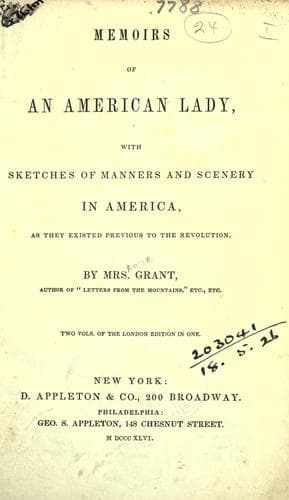
Memoirs of an American Lady: With Sketches of Manners and Scenery in America, as They Existed Previous to the RevolutionGrant, Anne MacVicar
History
Memoirs of an American Lady: With Sketches of Manners and Scenery in America, as They Existed Previous to the Revolution
Grant, Anne MacVicar
Indians of North America; New York (State) -- Social life and customs -- To 1775; Schuyler, Catalina, 1701-1778 or 1779
I have often heard my friend speak of an old man, who, being carried
away in his infancy by some hostile tribe who had slain his parents, was
rescued very soon after by a tribe of friendly Indians, who, from
motives of humanity, resolved to bring him up among themselves, that he
might, in their phrase, “learn to bend the bow, and speak truth.” When
it was discovered, some years after, that he was still living, his
relations reclaimed him, and the community wished him to return and
inherit his father’s lands, now become more considerable. The Indians
were unwilling to part with their protégé, and he was still more
reluctant to return. This was considered as a bad precedent; the early
settlers having found it convenient in several things regarding hunting,
food, &c. to assimilate in some degree with the Indians; and the young
men, occasionally, at that early period, joined their hunting and
fishing parties. It was considered as a matter of serious import to
reclaim this young alien, lest others should be lost to the community
and to their religion, by following his example. With difficulty they
forced him home—where they never could have detained him, had they not
carefully and gradually inculcated into his mind the truths of
christianity. To those instructions, even his Indian predilections
taught him to listen; for it was the religion of his fathers, and
venerable to him as such: still, however, his dislike of our manners was
never entirely conquered, nor was his attachment to his foster fathers
ever much diminished. He was possessed of a very sound intellect, and
used to declaim with the most vehement eloquence, against our crafty and
insidious encroachments on our old friends. His abhorrence of the petty
falsehoods to which custom has too well reconciled us, and those little
artifices which we all occasionally practise, rose to a height fully
equal to that felt by Gulliver. Swift and this other misanthrope, though
they lived at the same time, could not have had any intercourse, else
one might have supposed the invectives which he has put into the mouth
of Gulliver, were borrowed from this demi-savage; whose contempt and
hatred of selfishness, meanness, and duplicity, were expressed in
language worthy of the dean: insomuch, that years after I had heard of
this singular character, I thought, on reading Gulliver’s asperities,
after returning from Houyhnhnmland, that I had met my old friend again.
One really does meet with characters that fiction would seem too bold in
portraying. This original had an aversion to liquor, which amounted to
abhorrence; being embittered by his regret at the mischiefs resulting
from it to his old friends, and rage at the traders for administering
the means of depravity. He could never bear any seasoning to his food,
and despised luxury in all its forms.
Public-domain text, read in full here on John Shaqi.
Reviews
Reviews
No reviews yet
Be the first to share your thoughts on this work.
Elsewhere in the archive
Join the Discussion
Join the discussion
Sign in to leave a comment or review.
Sign InorCreate an account