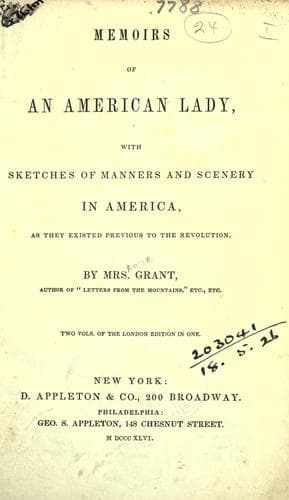
Memoirs of an American Lady: With Sketches of Manners and Scenery in America, as They Existed Previous to the RevolutionGrant, Anne MacVicar
History
Memoirs of an American Lady: With Sketches of Manners and Scenery in America, as They Existed Previous to the Revolution
Grant, Anne MacVicar
Indians of North America; New York (State) -- Social life and customs -- To 1775; Schuyler, Catalina, 1701-1778 or 1779
The great stumbling block which the missionaries had to encounter with
the Indians, (who, as far as their knowledge went, argued with great
acuteness and logical precision,) was the small influence which our
religion seemed to have over many of its professors. “Why,” said they,
“if the book of truth, that shows the way to happiness, and bids all men
do justice, and love one another, is given both to Corlaer, and
Onnonthio,[10] does it not direct them in the same way? Why does
Onnonthio worship, and Corlaer neglect, the mother of the blessed one?
And why do the missionaries blame those for worshipping things made with
hands, while the priests tell the praying nation[11] that Corlaer and
his people have forsaken the worship of his forefathers: besides, how
can people, who believe that God and good spirits view and take an
interest in all their actions, cheat and dissemble, drink and fight,
quarrel and backbite, if they believe the great fire burns for those who
do such things? If we believed what you say, we should not exchange so
much good for wickedness, to please an evil spirit, who would rejoice at
our destruction.”
Footnote 10:
Corlaer was the title given by them to the governor of New-York; and
was figuratively used for the governed, and Onnonthio for those of
Canada, in the same manner.
Footnote 11:
Praying nation, was a name given to a village of Indians near
Montreal, who professed the catholic faith.
To this reasoning it was not easy to oppose any thing that could carry
conviction to untutored people, who spoke from observation and the
evidence of the senses; to which could only be opposed scripture texts,
which avail not till they are believed; and abstract reasoning,
extremely difficult to bring to the level of an unlearned understanding.
Great labour and perseverance wrought on the minds of a few, who felt
conviction, as far as it is to be ascribed to human agency, flowing from
the affectionate persuasion of those whom they visibly beheld earnest
for their eternal welfare: and when a few had thus yielded,[12] the
peace and purity of their lives, and the sublime enjoyment they seemed
to derive from the prospects their faith opened into futurity, was an
inducement to others to follow the same path. This abstractedly from
religious considerations of endless futurity, is the true and only way
to civilization; and to the blending together the old and new
inhabitants of these regions. National pride, rooted prejudices,
ferocity, and vindictive hatred, all yield before a change that new
moulds the whole soul, and furnishes man with new fears and hopes, and
new motives for action.
Footnote 12:
Public-domain text, read in full here on John Shaqi.
Reviews
Reviews
No reviews yet
Be the first to share your thoughts on this work.
Elsewhere in the archive
Join the Discussion
Join the discussion
Sign in to leave a comment or review.
Sign InorCreate an account