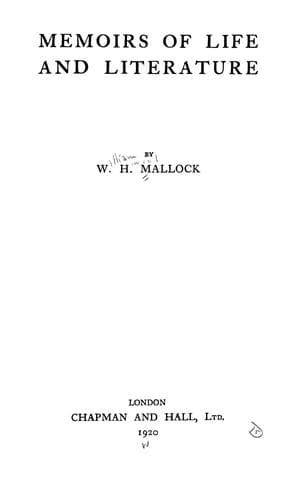
Memoirs of Life and LiteratureMallock, W. H. (William Hurrell)
General
Memoirs of Life and Literature
Mallock, W. H. (William Hurrell)
Mallock, W. H. (William Hurrell), 1849-1923
One May morning in London, when I had just completed a fortnight of
political speaking in Fifeshire, a friend of mine, Ernest Beckett
(afterward the second Lord Grimthorpe), came in a state of obvious
excitement to see me, and talk, so he said, about something of great
importance. He had, it appeared, been spending some weeks in the south
of France, and was full of a project the value of which had, so he said,
been amply proved by experiment. To me at first sight it seemed no
better than lunacy. I could not for some time even bring myself to
consider it seriously. This project was to play a new system at Monte
Carlo. It was a system founded on one which, devised by Henry
Labouchere, had been--such was Beckett's contention--greatly improved by
himself, and he and a companion had been playing it with absolutely
unbroken success. The two, with only a small capital in their pockets,
had won during the course of a week or so something like a thousand
pounds--not in a few large gains (for in this there would have been
nothing to wonder at), but by a regular succession day after day of
small ones. They had tested the system further by applying it, after
their departure, to the records, published daily in a Monte Carlo
journal, of the order in which colors or numbers had turned up
throughout the day preceding at some particular table. Adjusting their
imaginary stakes, in accordance with the rules of the system, to these
series of actual sequences, the two experimenters had discovered that
their original successes were, as a matter of theory, infallibly
reproduced. So certain, said Beckett, did all this seem that he would
himself be in a position to secure some thousands of pounds of capital
for the purpose of renewing the enterprise on a very much larger scale.
He would not be able till Christmas to go out to Monte Carlo himself,
and for several reasons he desired to remain at first in the background;
but the capital in question would, he said, include a sum sufficient to
defray the expenses of a few suitable friends, who would set to work
meanwhile, and be entitled, as a business matter, to a share of the
eventual profits. The coadjutors whom he had in view were myself, the
late Lord Greenock, Charles Bulpett, and Charles Edward Jerningham.
Moreover, as everything would depend on a correct calculation of the
stakes--the amount of which at each coup would vary with the results of
the coups preceding--and as this calculation would often be extremely
complicated, and have in every case to be made with extreme rapidity, a
good deal of preliminary practice on the part of the intending players
would be necessary. Would this little group of players be, as he hoped,
forthcoming? I still regarded the project as something of the wildcat
kind; but I was struck by the undoubted success of Beckett's own
experiments, actual and theoretical, so far; and, as the four players
would at all events lose nothing, even if they gained nothing, by
Public-domain text, read in full here on John Shaqi.
Reviews
Reviews
No reviews yet
Be the first to share your thoughts on this work.
Elsewhere in the archive
Join the Discussion
Join the discussion
Sign in to leave a comment or review.
Sign InorCreate an account