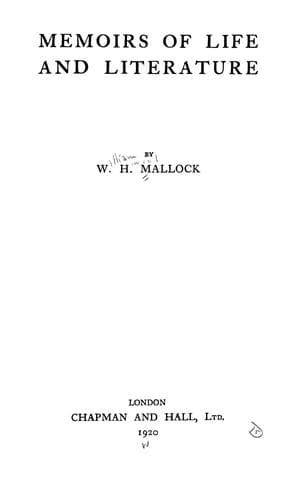
Memoirs of Life and LiteratureMallock, W. H. (William Hurrell)
General
Memoirs of Life and Literature
Mallock, W. H. (William Hurrell)
Mallock, W. H. (William Hurrell), 1849-1923
I was happy in having with me an admirable Austrian servant who had been
in the country before, and knew more or less of its ways. I found his
resources inexhaustible, except on one occasion. I stayed on the way at
Vicenza, for the purpose of seeing some of its Palladian palaces, and I
asked him, when I reached the hotel, to find some guide or waiter who
spoke either French or English. He could find no one who knew a syllable
of one tongue or the other. Next morning, however, he had secured an
Italian native who spoke and understood German. Here was all I wanted. I
spoke English to my servant, he spoke German to the Italian, the Italian
spoke to the people of whom I wanted to make inquiries. This
arrangement, I found, was productive of great advantages. Having made
notes of the palaces I wished to see, I told my Italian in each case to
inquire whether an English gentleman, much interested in architecture,
might be privileged to visit the interior, of the beauty of which he had
heard much. The fact that I was making my rounds with a retinue of two
attendants was accepted as such a guaranty of my own good character and
importance that I was admitted with the utmost courtesy to stately and
interesting interiors, from the portals of which I should otherwise have
been driven with suspicion and ignominy.
Having seen what I could at Vicenza, I spent a night at Treviso, whence,
having got up before sunrise, I drove in a weeping morning to the
wonderful Villa Maser, about twenty miles away--the villa whose halls
and chambers are gorgeous from end to end with the frescoes of Paul
Veronese, and whose tutelary gods look out over the vastness of the
Lombard plains, though their view is slightly impeded by the bulk of a
Renaissance church. That evening I ensconced myself in an ill-lit train,
which, passing close to Venice and crossing the Austrian frontier,
brought me and my servant to a strange little medieval town, where we
slept in an arcaded hostelry which would not have seemed strange to
Erasmus. I halted here because in the neighboring wonderland is, as I
knew from descriptions, a castle more fantastic than any fancy of
Albert Duerer's--the high-perched castle of Hoch-Osterwitz. I spent next
day in exploring it. It outdid all my dreams. Reached by a corkscrew
road which, passing through strange gatehouses, winds upward round an
isolated hill resembling a pine-clad sugar loaf, the castle covers the
summit. It suggested Tennyson's line to me: "Pricked with incredible
pinnacles into heaven." Not so large or terrific as St. Hilarion, it
inflicts perhaps on the imagination a yet acuter twinge, for St.
Hilarion belongs to an age so wholly dissociated from our own that the
distance between them is beyond the reach of measurement.
Hoch-Osterwitz, on the other hand, though in consequence of its
inconvenient position its owners no longer lived in it, was still not
wholly derelict. Its roofs were watertight; a portion of it was occupied
Public-domain text, read in full here on John Shaqi.
Reviews
Reviews
No reviews yet
Be the first to share your thoughts on this work.
Elsewhere in the archive
Join the Discussion
Join the discussion
Sign in to leave a comment or review.
Sign InorCreate an account