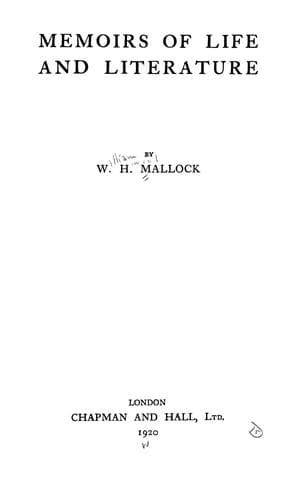
Memoirs of Life and LiteratureMallock, W. H. (William Hurrell)
General
Memoirs of Life and Literature
Mallock, W. H. (William Hurrell)
Mallock, W. H. (William Hurrell), 1849-1923
Of this volume, which was a criticism not only of Mr. Kidd, but of Mr.
Herbert Spencer also, the fundamental thesis was similar to that of
_Social Equality_, and of _Labor and the Popular Welfare_--namely, that
in proportion as societies progress in civilization and wealth all
appreciable progress, and the sustentation of most of the results
achieved by it, depend more and more on the directive ability of the
few; and this thesis was affiliated to the main conclusions of
evolutionary science generally. It was admitted that, within certain
limits, results achieved by the few were absorbed and perpetuated by the
many, though the activities of the originators might have ceased, and
that a proper definition of evolution pure and simple would be: "The
orderly sequence of the unintended." But, at the same time, it was shown
that an "orderly sequence of the unintended," though it is a part of
what we mean by progress, is a small part only, the major part still
requiring the intentional activities of the few, not only for its
initiation, but for its sustentation also.
This argument was set forth with great minuteness, and it was shown how
many most distinguished thinkers, while admitting its general truth,
were constantly obscuring it by formulae which were, in effect, denials
of it. Among the writers thus referred to was Mr. Herbert Spencer, who
in one passage described the Napoleonic wars as an incident in the
process of evolution and in another passage cited them as examples of
the results of the solitary wickedness of one super-capable man. With
regard to these issues I received some interesting letters from Mr.
Spencer himself. His contention was that I had quite misrepresented his
meaning. Economically, at all events, the functions of the super-capable
man were in his opinion as important as they possibly could be in mine.
I replied that if such were his opinion he very often obscured it, but
that I hoped he would acquit me of any conscious unfairness to himself.
His first letters were not without a touch of acerbity, but he ended
with amicably stating what his actual views were, and saying that if I
only amended certain passages relating to himself, he was in entire
agreement with my whole argument otherwise.
[Illustration: HERBERT SPENCER]
I never met Mr. Spencer, and of what he may have been in conversation I
have not the least conception; but a story is told of him which shows
that he must have had a vein of humor in him which his writings do not
suggest. His favorite relaxation was billiards. This game he played with
more than average skill, but on one occasion, much to his own chagrin,
he found himself hopelessly beaten by a very immature young man. "Skill
in billiards, up to a certain point, is a sign," he said, "of sound
self-training. Too much skill is a sign of a wasted life."
Public-domain text, read in full here on John Shaqi.
Reviews
Reviews
No reviews yet
Be the first to share your thoughts on this work.
Elsewhere in the archive
Join the Discussion
Join the discussion
Sign in to leave a comment or review.
Sign InorCreate an account