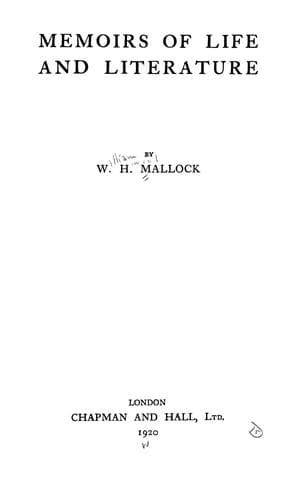
Memoirs of Life and LiteratureMallock, W. H. (William Hurrell)
General
Memoirs of Life and Literature
Mallock, W. H. (William Hurrell)
Mallock, W. H. (William Hurrell), 1849-1923
"fantastic tricks" which those who reject the supernatural are driven to
play in their attempts to provide the world with a substitute.
But every general event must have a general cause, for which individuals
are not alone responsible; and the fantastic tricks of the people who
try to make religions for themselves cannot be due merely to the
idiosyncrasies of exceptionally foolish persons. There must be causes at
the back of them of a deeper and a wider kind. The first of these causes
is obviously the fact that, for some reason or other, multitudes who
know nothing of one another are independently coming to the conclusion
that supernaturalism, which was once accepted without question as the
main content or substratum of human life, rests on postulates which to
them are no longer credible. Why is this the case to-day, when it was
not the case yesterday? Of these necessary postulates two are the same
for all men--namely, an individual life which survives, the individual
body, and the moral responsibility of the individual, or his possession
of a free will. A third postulate, which is the same for all orthodox
Christians, is the miraculous inspiration of the Bible, whatever the
precise nature of this inspiration may be. Of these three postulates the
last has been discredited all over the world by biblical criticism and
scientific comparisons of one religion with another. The first and the
second have been discredited by advances in the science of biological
physics which has, with increasing precision, exhibited human life and
thought as mere functions of the physical organism, the organism itself
being, in turn, a part of the cosmic process. If this be the case, what
religious significance can attach to the individual as such? His
thoughts, his emotions, his actions, are no more his own than the action
of a windmill's sails or the antics of scraps of paper gyrating at a
windy corner.[3] The first license to men to construct a religion is a
license given them by reason to admit the proposition that the
individual will is free. The primary obstacle to religious belief to-day
is the difficulty of finding in this universe a rational place for
freedom--a "_voluntas avolsa fatis_." How is this obstacle to be
surmounted?
To this question I attempted an answer in a new philosophical book,
_Religion as a Credible Doctrine_, of which the general contention is as
follows. If we trust solely to science and objective evidence, the
difficulty in question is insuperable. There is no place for individual
freedom in the universe, and apologists who attempt to find one are no
better than clowns tumbling in the dust of a circus. If they try to
smuggle it in through some chink in the _moenia mundi_, these ageless
walls are impregnable, or if here and there some semblance of a gate
presents itself, each gate is guarded, like Eden, by science with its
flaming swords.
Public-domain text, read in full here on John Shaqi.
Reviews
Reviews
No reviews yet
Be the first to share your thoughts on this work.
Elsewhere in the archive
Join the Discussion
Join the discussion
Sign in to leave a comment or review.
Sign InorCreate an account