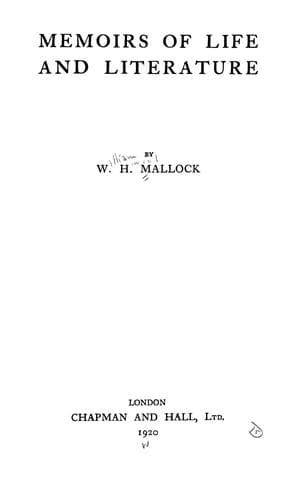
Memoirs of Life and LiteratureMallock, W. H. (William Hurrell)
General
Memoirs of Life and Literature
Mallock, W. H. (William Hurrell)
Mallock, W. H. (William Hurrell), 1849-1923
The intellectual argument of the book takes up the threads where
_Religion as a Credible Doctrine_ dropped them. It begins at the dinner
table, where a well-known case of cheating at cards is discussed, and
the issue is raised of whether, or how far, a rich man who cheats at
cards is the master of his own actions or the pathological victim of
kleptomania. One of the lights of the Jockey Club is indignant at the
idea that the matter can be open to doubt. "If a gentleman," he says,
"is not free to abstain from cheating, what would become of the turf?
Eh, bishop--what would become of the Church? What would become of
anything?" Thus the question of free will is once again in the air, and
the more serious of the guests, as soon as the others depart, set
themselves to discuss both this and other questions kindred to it.
Of such other questions the most obvious is this: "How far do educated
persons, who are nominally 'professing Christians,' really believe in
doctrines of Christian orthodoxy, and more particularly in the authority
and supernatural inspiration of the Bible?" Most of them are obliged to
confess that at best they are in a state of doubt. On Sunday three
Anglican clergymen are imported on a steam launch from a watering place
some ten miles off, where they are attending a clerical Congress--an
Evangelical, a Broad Churchman, and a Ritualist; and they administer to
the company three competitive sermons.
These performances leave confusion worse confounded; and the guests
during the following days set themselves to pick their own beliefs to
pieces. At last they come back to the question of free will, especially
as related to science and what is called scientific materialism. Then
the question arises of "What do we mean by matter?" and then the
question of the possible goodness of a God who, if he is really the
power behind evolution, is constantly sacrificing the unit to the
development of the race or species. This last difficulty is expressed by
one of the disputants in a poem which had been written many years ago,
and which, by request of the company, he recites. In this poem the man,
who is vowed to abandon every belief for which science can make no room,
is represented by a wanderer who finds himself at last conducted to a
bare region where no living thing is discernible, but one shining
apparition standing on the brink of a promontory which juts into a
sailless sea. He approaches, and addresses it thus:
"Oh, angel of the heavenly glow,
Behold I take thine hands and kneel.
But what is this? Thy brows are snow,
Thy hands are stone, thy wings are steel.
"The radiant pureness of thy face
Has not the peace of Paradise,
Those wings within the all-holy place
Were never folded o'er thine eyes.
"And in thine eyes I see no bliss,
Nor even the tenderness of tears.
I see the blueness of the abyss,
I see the icebergs and the spheres.
Public-domain text, read in full here on John Shaqi.
Reviews
Reviews
No reviews yet
Be the first to share your thoughts on this work.
Elsewhere in the archive
Join the Discussion
Join the discussion
Sign in to leave a comment or review.
Sign InorCreate an account