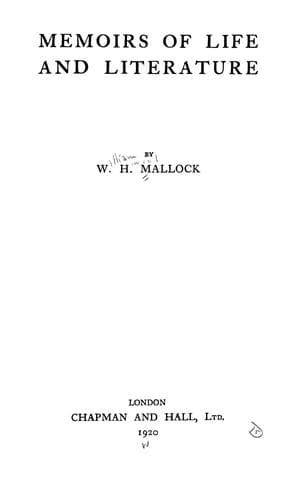
Memoirs of Life and LiteratureMallock, W. H. (William Hurrell)
General
Memoirs of Life and Literature
Mallock, W. H. (William Hurrell)
Mallock, W. H. (William Hurrell), 1849-1923
Of the peril of these seas our captain had often spoken, and when,
leaving the stillness of Loch Laxford, we renewed our northward journey,
we soon perceived that his language was not exaggerated. From the mouth
of Loch Laxford to Cape Wrath the whole coast might have represented to
Dante the scowling ramparts of hell. Of anything in the nature of a
beach no trace was discernible. The huge cliffs, rising sheer from the
sea, leaned not inward, but outward, and ceaseless waves were breaking
in spouts of foam against them. The yacht began to roll and pitch, so
that though none of us were sick except Mrs. Noble's maid, we could very
few of us stand. We managed, however, to identify the lighthouse and
megaphone of Cape Wrath just peeping out of the cliffs, as though they
were themselves afraid to meet the full violence of a storm. The skill
of the cook, however, and the intrepidity of hunger enabled us to eat
our luncheon. We then lay down in our several cabins and slept, till
steps on deck and a number of voices woke us. We were soon rolling more
disagreeably than ever. But this added annoyance did not last for long.
Something or other happened. The motion of the vessel became easier, and
at last, peeping into my cabin, Saxton Noble announced that we were back
again in Loch Laxford. The megaphones of Cape Wrath had announced that a
fog was coming. The captain had fled before it, and we dined that night
at a table as stationary and steady as any in any hotel in Glasgow. Next
day the weather was clear. We rounded the terrible headland, and were
floating at ease that evening on the glassy surface of Loch Erribol. In
this half-sylvan seclusion we rested for several days. Thence some eight
hours of steaming brought us to the roadstead of Thurso. For several
days we lay there while the yacht rocked uneasily, and most of our time
was spent in expeditions on dry land. In some ways Thurso was curious.
On the one hand, the shops were excellent. They might have been those
of a country town near London. On the other hand, the older houses were,
as a protection against storms, roofed with ponderous slabs hardly
smaller than gravestones. At one end of the town was Thurso Castle, the
seat of Sir Tollemache Sinclair, its walls rising out of the water. At
the back of it was a small wood--the only wood in Caithness. I knew Sir
Tollemache Sinclair well, but unfortunately he was not at home. He was
what is called "a character." He had strong literary tastes, and firmly
believed that he understood the art of French versification better than
Victor Hugo. The last time I had seen him was at a hotel in Paris. He
was on that occasion in a mood of great complacency, having just been
spending an hour with Victor Hugo at luncheon. I asked him if, with
regard to French versification, Victor Hugo agreed with him. "No," he
replied, honestly, "I can't say that he did; but he asked me to lunch
again with him whenever I should be next in Paris."
Public-domain text, read in full here on John Shaqi.
Reviews
Reviews
No reviews yet
Be the first to share your thoughts on this work.
Elsewhere in the archive
Join the Discussion
Join the discussion
Sign in to leave a comment or review.
Sign InorCreate an account