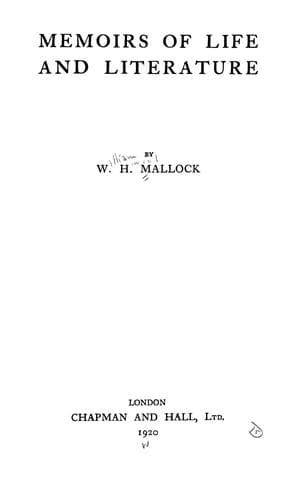
Memoirs of Life and LiteratureMallock, W. H. (William Hurrell)
General
Memoirs of Life and Literature
Mallock, W. H. (William Hurrell)
Mallock, W. H. (William Hurrell), 1849-1923
But our peace in a physical sense was very abruptly broken when we
quitted Kirkwall en route for the Holy Grail of our pilgrimage, Noltland
Castle, which secludes itself on the far-off island of Westray, and,
leaving the quiet of Scapa Flow behind us, encountered once more the
tumults of the Pentland Firth. But these were nothing in comparison with
those that met us as soon as we had rounded the southwest corner of Hoy.
The hills of Hoy, so far as we had yet seen them, were of no very great
magnitude; but now, as we went northward, they showed themselves as a
line of tremendous precipices, which rose from the booming waves to an
altitude of twelve hundred feet. This monstrous wall ended where a
narrow and mysterious fiord separates Hoy from a low-hilled island north
of it. This island gave place to another, and at last, late in the day,
our captain told us that we were passing the outer shore of Westray.
Consulting our maps, and pointing to the mouth of some new fiord, we
asked him if it would not afford us a short cut to our destination. He
told us that it was full of hidden rocks and sandbanks, and called our
attention to some enigmatic object which rose in midchannel like a
deer's horns from the sea. "There," he said, "are the masts of an
Icelandic steamer which attempted two years ago to make that passage,
and was lost. To reach Westray in safety we must double its farthest
promontory." An hour or two later this feat was accomplished. We were
once more in smooth water, and found ourselves quietly floating toward
something like a dwarf pier and one or two small white houses. By now it
was time for dinner, and having dined in a saloon that was hung with
jade-green silk, we leaned over the bulwarks and contemplated the remote
scene before us. We could just discern by the pier some small tramp
steamer reposing. In the little white houses one or two lights twinkled,
and presently, not far off, we distinguished a mouse-colored something,
the upper outlines of which resolved themselves into high gables. Like
Childe Roland when he came to the dark tower, we realized that these
were the gables of Noltland Castle. Next morning we explored this
building. The main block consisted of a tower unusually large, in the
middle of which was a great red-sandstone staircase winding round a
newel which culminated in a heraldic monster. This staircase led to a
great hall, roofless, but otherwise perfect. Above it had once been
bedrooms. On the ground floor were vaulted offices, including a hearth
as large as the kitchen of a well-built cottage. Attached to the tower
was a court. Ruined chambers surrounded it, in which guests, their
retinues, and the servants of the house once slept. Island chieftains
once met and reveled here. Here also for a time the most beautiful woman
in Europe--Mary Stuart, as a captive--looked out at the sea.
Public-domain text, read in full here on John Shaqi.
Reviews
Reviews
No reviews yet
Be the first to share your thoughts on this work.
Elsewhere in the archive
Join the Discussion
Join the discussion
Sign in to leave a comment or review.
Sign InorCreate an account