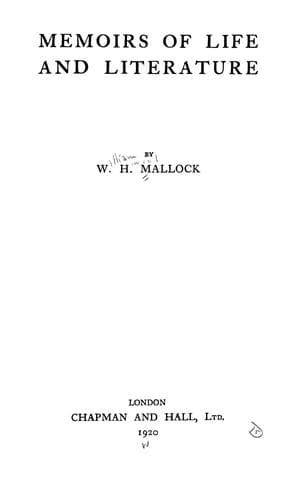
Memoirs of Life and LiteratureMallock, W. H. (William Hurrell)
General
Memoirs of Life and Literature
Mallock, W. H. (William Hurrell)
Mallock, W. H. (William Hurrell), 1849-1923
The mention of Elvaston carries my thoughts to Cardiff. Cardiff Castle
till late in the nineteenth century was mainly, though not wholly,
ruinous, and some decades ago it was, at enormous expense, reconstructed
by the late Lord Bute. All the lore of the architectural antiquarian was
ransacked in order to consummate this feat. Indeed the wealth of detail
accumulated and reproduced by him will be held by many people to have
defeated its own ends. Ornaments, carvings, colorings, of which ancient
castles may severally offer single or a few specimens, were here crowded
together in such emphatic profusion as to fill the mind of the spectator
with a sense of something novel rather than of anything antique. In a
certain spectacular sense Cardiff Castle is large, but for practical
purposes it is very much the reverse. I stayed there--and this was my
first introduction to Wales--for the Eisteddfod, of which for that year
Lord Bute was the president. The house party on the occasion comprised
only eight persons, and there was, so I gathered, no room for more. Lord
Bute was by temperament a man of extreme shyness, who naturally shrank
from obtruding his own person in public, but on this occasion he rose to
a full sense of his obligations. He prepared and delivered an address,
most interesting and profoundly learned, on Welsh musical history. He
and his house party were conveyed to the place of meeting in quasi-royal
carriages, preceded and followed by outriders, and for a series of
nights he provided the inhabitants of the town with balls, concerts, or
entertainments of other kinds. No host could have been more gracious
than he. On the last night of my visit there was a gathering practically
private. The heroine of this was old Lady Llanover, who, though not a
native of Wales, was an enthusiast for all things Welsh. She had brought
with her in her train a bevy of her own female domestics, who wore
steeple-crowned hats, and also an old butler dressed up like a bard.
These were all arranged on a dais, and sang national melodies; and when
the performance was finished Lord Bute, with a charming smile, presented
Lady Llanover with a ring. This bore on its large gem an engraving of a
Welsh harp, below which was the motto in Welsh, "The language of the
soul is in its strings."
Among my fellow guests at the Castle was a singularly interesting
personage--Mr. George Clark of Talygarn. Mr. Clark, in alliance with
Lord Wimborne, played a prominent part in the development of the Dowlais
steel works, and he was at the same time one of the greatest
genealogists and heraldic antiquarians of his day. I was intimate with
him till his death, and have been intimate with his family ever since.
Apart from St. Michael's Mount, there are two old houses in Cornwall
which year after year I visited for some part of December, proceeding
thence to a third for a Christmas gathering in Worcestershire, and to a
fourth--this was in Yorkshire--for the celebration of the New Year.
Public-domain text, read in full here on John Shaqi.
Reviews
Reviews
No reviews yet
Be the first to share your thoughts on this work.
Elsewhere in the archive
Join the Discussion
Join the discussion
Sign in to leave a comment or review.
Sign InorCreate an account