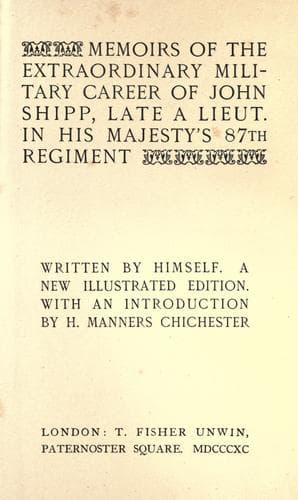
Memoirs of the Extraordinary Military Career of John Shipp: Late a Lieut. in His Majesty's 87th RegimentShipp, John
History
Memoirs of the Extraordinary Military Career of John Shipp: Late a Lieut. in His Majesty's 87th Regiment
Shipp, John
India -- History -- British occupation, 1765-1947 -- Biography; Shipp, John, 1784-1834
the flinty rocks, or offering our shattered limbs as wadding for the
enemy's guns, or our bodies to fill up some deep vacuity in their new
and numerous stockades. We had more than fifty years' dear-bought
experience, and an officer seventy years of age for our guide. The young
and inexperienced officers, in the ardour of youth, felt mortified at
this information; and, had their will and feelings been consulted, they
would have madly rushed to their graves.
It was the opinion of the more calm-thinking and experienced men, that
if, after the information we possessed, we had proceeded in the same
track, and a failure had been the result, the whole dishonour of the
catastrophe would have fallen on the head of the commander, and have
been visited with the government's disapprobation and censure; but we
had at our head a soldier possessing every requisite for such a critical
campaign, and whose thoughts were now turned to some more practicable
part of the country. Every one was actively engaged in the attempt to
discover some new road, path, or ascent. Spies had now been absent two
days, and some apprehensions were entertained as to their safety,
knowing the barbarity of the Nepaulese; but on the evening of the third
day they returned; but not a syllable could be gleaned from the
quarter-master-general's department; every ear was on the listen to
catch the slightest hint, but all was silence and secrecy throughout the
camp. Rumours were flying about, and strange stories were circulated;
but the prevailing opinion was, that we must give up the campaign, on
account of an impossibility of access into the enemy's country. This was
a death-blow to our hopes. The attempt to force the entrance above
alluded to, would have been through the Chirecah Ghattie pass; but this
was wisely given up as hopeless. There was a small ravine branching off
from the bed of a dry river, in which our encampment lay, and its
entrance looked like the dreary access to some deep cavern. From thence
the spies last came. The moon rose in all her splendour, gilding the
tops of the golden-leaved trees; and all was silent, save the falling of
the distant cataract, when a faint whisper, borne on the refreshing
breeze of night, said, "Prepare to move;" and in one hour after, we
entered this little gaping cavern, leaving the principal part of our
force for the protection of our standing tents and baggage. We were
equipped as lightly as possible. Two six-pounders were conveyed on
elephants, and our march seemed to lie through the bed of this ravine,
which was rocky, and watered by a crystal current that rippled along its
flinty bed. We did not proceed at the rate of more than one or two
hundred yards an hour, ascending and descending every twenty paces; at
one time deep sunk in some dark excavation, and shortly afterwards
perched upon the summit of a rock, the falling of the numerous cataracts
drowning the noise made by our approach. The night was cold and chilly,
Public-domain text, read in full here on John Shaqi.
Reviews
Reviews
No reviews yet
Be the first to share your thoughts on this work.
Elsewhere in the archive
Join the Discussion
Join the discussion
Sign in to leave a comment or review.
Sign InorCreate an account