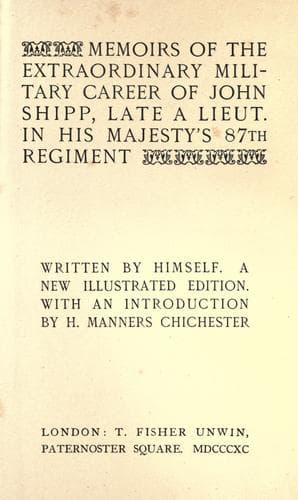
Memoirs of the Extraordinary Military Career of John Shipp: Late a Lieut. in His Majesty's 87th RegimentShipp, John
History
Memoirs of the Extraordinary Military Career of John Shipp: Late a Lieut. in His Majesty's 87th Regiment
Shipp, John
India -- History -- British occupation, 1765-1947 -- Biography; Shipp, John, 1784-1834
country you could not tell but your next step might be in the cannon's
mouth. I was thus thinking, when I saw the adjutant running towards the
centre of the regiment, vociferating, "Pass the word for Mr. Shipp; pass
the word for Mr. Shipp."--"Holloa!" thought I, "what's all this about?".
At last he came up to me, and said I was to join the light company
immediately. This was making me a light bob, indeed. I made over the
colour to my covering sergeant, by the adjutant's desire; but at that
moment a thought struck me, that perhaps this was the last time I should
ever bear it; for I could not foresee but that that day--nay, that
fleeting hour--might be my last; so I pressed the colour to my bosom and
kissed it: why should I be ashamed of it? I was a soldier, and the oft
blood-stained banner was my pride.
I soon joined the light bobs, for I could run and jump with the best of
them, and the column now proceeded slowly. The fine light company of the
25th regiment of Bengal Native Infantry were with us, and there was the
greatest intimacy between this native company and ours, and more
familiarity and good-fellowship than I had ever witnessed during my
course of service in India. We now ascended a small hill, at the bottom
of which we saw several men running away. Our soldiers were not cruel,
nor did they ever wantonly throw away their fire. A soldier ought to
guard every round intrusted to his care, for the protection of his
country and himself, as the apple of his eye; many a brave man has lost
his life in battle for the want of a round of ammunition, which, in all
probability, he had been careless of at the beginning. It is not only a
crime, but a folly, for men to be wanton in this particular. I took
about ten men with me, and the acting adjutant followed, and we soon
came up with these poor frightened and bewildered creatures. They threw
themselves on the earth, but did not supplicate for mercy--a thing
unknown among themselves. They seemed rather to meet the pointed
bayonet, than to run or cringe from it; but, when they saw that we did
not lay on them the finger of harm, they kissed our feet and then the
earth, in token of gratitude. These poor creatures were not soldiers,
but poor, solitary, and oppressed villagers, that had been sent for
rice, of which they carry great loads, by a strap or belt over their
heads, in baskets made of the willow-twig. We were directed by our
general to let them go, that they might tell our enemies that we were
not bloodthirsty murderers. When this was communicated to them by one of
their countrymen, the eye of fear brightened up; we could see the tear
of joy in their eyes; they bowed, a hundred times in the most abject
prostrations to our feet; then stood towards their village, seemingly
dispossessed of any fear. I dare say these poor starving creatures would
willingly have sought protection under the shadow of our mercy, rather
than return to be the slaves of a tyrannic government.
Public-domain text, read in full here on John Shaqi.
Reviews
Reviews
No reviews yet
Be the first to share your thoughts on this work.
Elsewhere in the archive
Join the Discussion
Join the discussion
Sign in to leave a comment or review.
Sign InorCreate an account